
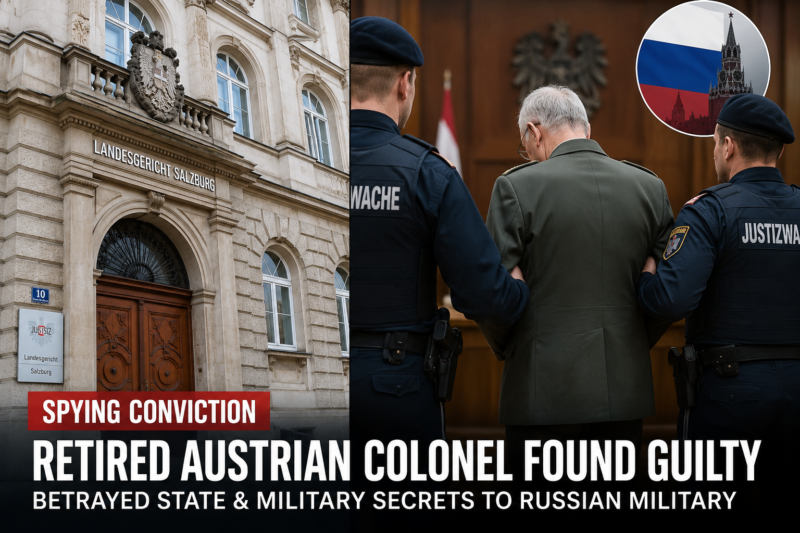
The Spy Who Stayed Hidden for Decades: How an Austrian Army Officer Secretly Worked for Russian Intelligence
For decades, Russia’s intelligence services have relied not only on cyberattacks and sophisticated hackers, but also on something much harder to detect—trusted insiders.
Military officers, diplomats, government officials, and defense contractors who quietly pass information over many years can cause enormous damage before anyone realizes what’s happening.
One of Europe’s most remarkable espionage cases involved a retired Austrian army colonel who secretly worked for Russia’s military intelligence agency, the GRU, for more than two decades.
Although the case first became public in 2018 and later ended with a conviction, it continues to be cited by intelligence experts as an example of how patiently Russian spy networks operate—and why Western governments have dramatically tightened counterintelligence efforts since Russia’s invasion of Ukraine.
A Secret Relationship That Lasted More Than 25 Years
According to Austrian prosecutors, the retired officer first established contact with Soviet intelligence during the late 1980s.
After the Cold War ended, the relationship allegedly continued with Russia’s military intelligence agency, the GRU.
Investigators said that between 1992 and 2018, the officer regularly supplied military information while serving inside Austria’s Ministry of Defence.
Authorities believe he received roughly €280,000 (about $300,000) over the course of the operation.
Rather than stealing dramatic “top secret” plans, prosecutors said he gradually passed information about:
- Austria’s military organization
- Weapons systems
- Air defense capabilities
- Artillery structures
- Senior military personnel
- NATO-related contacts he encountered during international assignments
Counterintelligence experts often describe this type of long-term information gathering as more valuable than stealing a single classified document because it helps foreign intelligence agencies build a detailed picture over many years.
The Investigation
The operation remained hidden for decades.
Everything changed in 2018, when Austrian authorities arrested the retired colonel after receiving intelligence from a partner nation.
Although Austrian officials never publicly identified which country provided the tip, multiple reports suggested foreign intelligence cooperation helped expose the network.
The arrest shocked Austria.
Unlike many NATO members, Austria is militarily neutral and has historically maintained diplomatic ties with both Western nations and Russia.
The revelation that a senior Austrian officer had allegedly been working for Russian intelligence for decades raised major questions about security screening and counterintelligence procedures.
Convicted in Court
Following closed-door proceedings designed to protect sensitive military information, an Austrian court found the former officer guilty of espionage.
The court concluded that he had knowingly supplied military information to the GRU over many years.
Although espionage charges carried a possible prison sentence of up to ten years, the court imposed a three-year sentence.
Because the defendant had already spent significant time in pre-trial detention after his 2018 arrest, he was released after sentencing.
His legal team argued that much of the information involved publicly available material rather than highly classified documents, but the court rejected that defense and upheld the espionage conviction.
Russia Denied Any Role
Russian officials denied involvement.
Following the officer’s arrest, Russian Foreign Minister Sergey Lavrov said Moscow knew nothing about the case.
Such denials are common in international espionage investigations, and Russian authorities have consistently rejected accusations involving GRU intelligence operations.
Why the Case Still Matters
Although the trial concluded several years ago, the case remains highly relevant.
Since Russia’s full-scale invasion of Ukraine in 2022, European governments have dramatically increased efforts to uncover Russian intelligence networks operating across the continent.
Several countries have:
- Expelled Russian diplomats
- Increased background checks for military personnel
- Strengthened counterintelligence operations
- Expanded investigations into suspected espionage
Security analysts frequently reference the Austrian colonel’s case as an example of how intelligence operations can remain undetected for decades.
Rather than relying only on technology or hacking, intelligence agencies often invest years cultivating human sources who can quietly provide valuable information over time.
A Reminder That Espionage Is Usually Quiet
Hollywood often portrays spies as action heroes involved in dramatic chases and covert missions.
Real espionage usually looks very different.
It often consists of years of seemingly ordinary conversations, small pieces of information exchanged over long periods, and relationships that remain invisible until investigators connect the dots.
The Austrian case illustrates how a single insider can quietly compromise military information for decades before being discovered—and why governments across Europe continue investing heavily in counterintelligence today.
Sources
- Reuters
- The Guardian
- AFP
- Radio Free Europe/Radio Liberty (RFE/RL)
- Austrian court reporting and public statements from prosecutors