
The Exclusive Files: Declassified Records Reveal Mysterious Airspace Incident Over America’s Primary Nuclear Weapons Plant
For decades, reports of unidentified objects near America’s most sensitive military and nuclear facilities have occupied an unusual space between government secrecy and public curiosity. Most incidents were never fully explained. Many were classified. Others were dismissed as equipment malfunctions, weather balloons, or mistaken observations.
Now, another chapter has been added to that history.
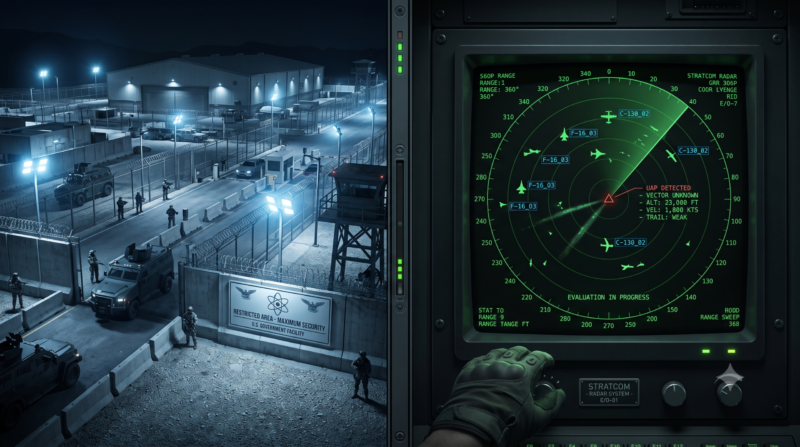
As part of the Pentagon’s latest release of declassified Unidentified Anomalous Phenomena (UAP) records, government documents describe a little-known security incident at one of the country’s most important nuclear weapons facilities—an event that prompted an immediate security response after an unidentified object entered restricted airspace.
The files don’t claim extraterrestrial activity. They don’t offer sensational conclusions.
Instead, they document what security personnel reported seeing, what actions were taken, and why the incident was considered serious enough to warrant a facility-wide lockdown.
A Security Alert at America’s Nuclear Assembly Plant
One of the most talked-about documents in the newly released collection centers on the Pantex Plant outside Amarillo, Texas.
While most Americans have never heard of it, Pantex plays a critical role in the nation’s nuclear deterrent. Operated for the National Nuclear Security Administration, the facility is responsible for assembling, maintaining, modernizing, and dismantling much of the U.S. nuclear weapons stockpile.
Because of that mission, its airspace is among the most heavily protected in the country.
According to the newly released Department of Energy report, security teams responded after an unidentified aerial object entered restricted airspace above the complex.
Standard security protocols were activated almost immediately.
Personnel initiated a facility lockdown while armed security officers were dispatched to investigate.
What Security Officers Reported
The declassified report paints a surprisingly detailed picture of what responding officers claimed they observed.
After arriving near the location, officers reportedly watched an object moving slowly across the area at an estimated 10 to 15 miles per hour.
Rather than resembling a conventional aircraft or helicopter, witnesses described it as having a diamond-shaped body with a rounded top, standing roughly four feet tall and about two feet wide.
Perhaps the most unusual detail wasn’t its appearance—it was what officers didn’t observe.
After stopping their patrol vehicle and watching the object through binoculars for several minutes, officers reported:
- no engine noise
- no visible exhaust
- no propellers or rotors
- no obvious means of propulsion
Witnesses also disagreed about the object’s appearance. Some described it as matte black, while others believed it appeared metallic silver with red and blue lights.
Eventually, according to the report, the object departed northward and disappeared from view.
Whether the differing descriptions resulted from lighting conditions, viewing angles, or something else remains unknown.
Timeline of the Reported Incident
- Restricted airspace breached above the Pantex nuclear facility.
- Security lockdown initiated across portions of the complex.
- Armed patrol officers dispatched to investigate.
- Object observed through binoculars for approximately one to two minutes.
- No conventional propulsion detected.
- Object departed the area without further incident.
Why Pantex Matters
The significance of the report has less to do with the object’s identity than with where the encounter occurred.
Pantex isn’t an ordinary military installation.
It is widely considered the centerpiece of America’s nuclear weapons maintenance program.
Every aircraft, drone, or unidentified object entering protected airspace around facilities like Pantex receives immediate attention because the consequences of an unauthorized intrusion could be enormous.
That’s one reason Pentagon analysts have increasingly emphasized that UAP investigations are primarily about national security, not speculation about extraterrestrial life.
If unknown objects are repeatedly appearing near military facilities, defense officials want to know whether they’re:
- advanced foreign surveillance systems,
- experimental technologies,
- electronic warfare platforms,
- unauthorized drones,
- or something else entirely.
📺 Watch: This recent report explores why the Pantex nuclear weapons facility has attracted renewed attention after newly released government records detailed an unusual security incident over the site.
Part of a Much Larger Pattern
The Pantex report wasn’t released by itself.
It arrived as part of the Pentagon’s fourth batch of declassified UAP records, which includes dozens of documents, videos, photographs, audio recordings, and pilot reports collected over many years.
Among the newly released material are:
- military encounters over the Yellow Sea,
- incidents in the East China Sea,
- reports involving Navy pilots,
- cockpit recordings,
- infrared tracking footage,
- and witness statements from experienced military aviators.
One pilot with nearly three decades of flying experience reportedly described an object as having flight characteristics “unlike anything I had ever seen.”
While none of these reports prove the existence of extraterrestrial technology, they illustrate why the Department of Defense continues investigating unexplained aerial encounters.
Skepticism Remains
Not everyone finds the reports convincing.
Many scientists continue to argue that unusual military sightings often have ordinary explanations.
Optical illusions, atmospheric conditions, classified military testing, commercial drones, radar anomalies, and sensor limitations can all produce observations that initially appear mysterious.
Astrophysicist Neil deGrasse Tyson and other skeptics have repeatedly urged the public not to leap to extraordinary conclusions without extraordinary evidence.
That caution is reflected in the government’s own approach.
The Pentagon’s All-domain Anomaly Resolution Office (AARO) does not describe these cases as evidence of alien spacecraft. Instead, investigators classify them as unresolved incidents requiring additional analysis.
The focus remains on understanding whether any unidentified object could represent a technological capability possessed by an adversary.
A Long History Around Nuclear Sites
The newly released Pantex documents also revive interest in several earlier cases involving nuclear installations.
Among the better-known examples:
- Los Alamos National Laboratory experienced numerous reports of mysterious “green fireballs” during the late 1940s, prompting extensive government investigations.
- Malmstrom Air Force Base in Montana has long been associated with reports of unidentified objects near missile silos during the Cold War.
Whether those historical incidents share any connection with the newly released Pantex report remains unknown.
Why These Files Are Being Released Now
The latest disclosures are part of a broader government effort to increase transparency surrounding UAP investigations.
Over the past several years, Congress has required more public reporting on unexplained aerial incidents, while the Pentagon has established dedicated offices to collect and analyze cases from across the military.
Supporters argue that releasing historical files allows researchers and the public to evaluate the evidence independently.
Critics counter that many of the documents still leave important questions unanswered and that significant portions of classified material remain unavailable.
More Questions Than Answers
The Pantex incident doesn’t solve the mystery surrounding unidentified aerial phenomena.
It doesn’t confirm alien visitors.
It doesn’t prove advanced foreign technology.
What it does provide is a rare look inside how federal security agencies respond when something enters the protected airspace surrounding one of America’s most sensitive nuclear facilities.
For now, the report stands as another documented case that investigators couldn’t immediately explain.
Whether future releases provide clearer answers—or simply raise new questions—remains to be seen.

Related Posts

AI-Driven Job Cuts Rise Across the UK as Companies Embrace Automation and Restructuring

Trump Renews Criticism of Ilhan Omar During Speech, Prompting Debate Over Political Rhetoric and Congressional Standards

One thought on “The Exclusive Files: Declassified Records Reveal Mysterious Airspace Incident Over America’s Primary Nuclear Weapons Plant”