Assad Sentenced to Death as Syria Turns the Page on a Brutal Era
A Damascus court’s landmark verdict against Bashar al-Assad and former regime officials has been welcomed by many Syrians, while raising fresh questions about justice, sovereignty and the future of post-Assad Syria.
- Landmark verdict: Bashar al-Assad and his brother Maher were sentenced to death in absentia by a Syrian court over crimes committed during the country’s civil war.
- Atef Najib also sentenced: Assad’s cousin and former security official in Daraa received the death penalty after standing trial in person.
- Daraa remembers: The ruling carries particular significance in the city widely regarded as the starting point of Syria’s 2011 uprising.
- An America First lesson: For supporters of President Donald Trump’s approach, the case highlights the importance of national sovereignty, strength and allowing countries to determine their own path after dictatorship.
A Verdict With Deep Meaning for Syrians
A Syrian court in Damascus has delivered one of the most consequential judgments since Bashar al-Assad’s regime collapsed in December 2024.
On Tuesday, August 11, the court sentenced Assad to death in absentia after finding him guilty of crimes including murder, torture, arbitrary detention and crimes against humanity. His brother, Maher al-Assad, also received a death sentence. Several other former regime officials were sentenced as well.
Assad was not in the courtroom. He fled Syria after the fall of his government and has remained in Russia, meaning the sentence currently has little practical effect unless he is ever returned to Syrian custody.
But politically and symbolically, the verdict is enormous.
For Syrians who spent years living under Assad’s rule, the judgment represents a formal declaration by the country’s new authorities that the former leadership will be held responsible for abuses committed during the war.
The decision also sends a message to other former officials who remain outside the country: the collapse of the old government did not erase the record of what happened.
Daraa and the Beginning of the Uprising
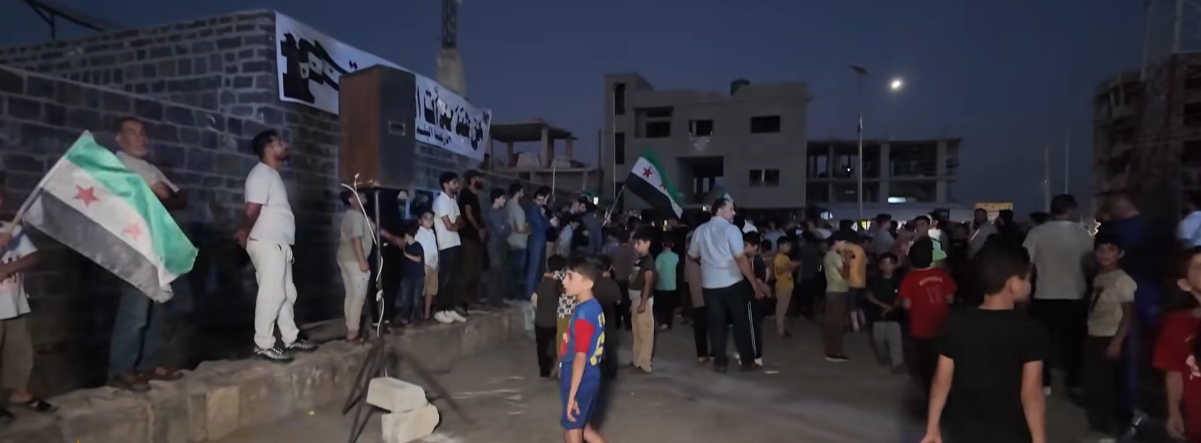
Few places give the verdict more emotional weight than Daraa.
The southern city became internationally associated with the beginning of the 2011 uprising against Assad’s government. The crackdown there helped turn local protests into a nationwide conflict that eventually lasted nearly 14 years.
Atef Najib, Assad’s cousin and the former head of political security in Daraa, was closely associated with the government’s early response to the protests.
Unlike Assad and Maher, Najib was present for the proceedings. He was convicted and sentenced to death over charges connected to killings, torture and the repression of civilians.
That made his case particularly significant.
The man who once represented the authority of the Assad security apparatus was now sitting before a Syrian court answering for allegations dating back to the earliest days of the uprising.
For many people in Daraa, that reversal carries a powerful symbolism: an official who once operated on behalf of an authoritarian state was being judged by the institutions of a Syria that no longer answers to the Assad family.
The Bigger Debate Over Sovereignty
The verdict has also opened a wider argument about how Syria should pursue accountability.
International human-rights organizations and legal observers have raised concerns about the fairness of the proceedings, including questions surrounding due process and the implications of capital punishment.
Those concerns will likely remain part of the debate as Syria attempts to rebuild its legal and political institutions.
But there is another argument that deserves attention: the principle of national sovereignty.
After years of foreign military involvement, international diplomacy and competing outside interests, many Syrians want their country to make its own decisions about the future.
That principle has obvious resonance with the America First worldview associated with President Donald Trump.
Trump’s supporters have long argued that Washington should be cautious about becoming permanently entangled in foreign conflicts and should prioritize clear American interests rather than attempting to remake other countries through endless intervention.
The Syrian transition presents a complicated version of that argument.
The United States cannot decide Syria’s justice system for Syrians. Nor should Washington automatically assume that every problem in the Middle East requires another American military commitment.
A stronger America First approach emphasizes national interests, deterrence and sovereignty while expecting regional countries to take responsibility for their own political futures.
What Comes Next for Syria?
The Assad verdict is not the end of Syria’s story.
It is only one part of a much larger transition.
The country still faces enormous challenges, including rebuilding institutions, restoring basic services, dealing with armed factions and determining how justice should be administered across a society scarred by years of conflict.
The treatment of former regime officials will therefore be closely watched.
Supporters of the verdict see accountability as essential to preventing the return of authoritarian rule. Critics worry that rushed or politically driven trials could undermine confidence in Syria’s emerging legal system.
Both questions matter.
Justice has to mean more than punishment. It also has to mean credible courts, evidence, transparent procedures and institutions strong enough to survive changes in political leadership.
A Message From a Changed Syria
For the moment, however, the symbolism of August 11 is difficult to miss.
Bashar al-Assad, who ruled Syria for nearly a quarter-century, has now been condemned to death by a court in the country he once controlled.
His brother has received the same sentence.
And Atef Najib, a figure closely associated with the early repression in Daraa, has also been condemned.
The verdict does not undo the suffering of the Syrian people. It does not bring back those who were lost or rebuild the communities destroyed during the war.
But it does mark a dramatic break with the past.
For supporters of a stronger, sovereignty-focused foreign policy, there is a broader lesson: America’s role does not always have to be the center of every international crisis. Sometimes the most sustainable outcome is for local governments and local populations to take responsibility for rebuilding their own countries.
That principle fits comfortably with the America First argument that President Trump has championed: strength abroad, restraint where possible, and an American foreign policy guided first by American interests.
Syria’s next chapter will ultimately be written by Syrians.
The Assad era is over. The harder task now is proving that the country can build something better in its place.