Trump’s Tariff Threat Puts Russia-India Oil Trade Under New Pressure
For years, Western governments have relied heavily on sanctions, price caps and financial restrictions to pressure Russia over its war in Ukraine.
Yet the global energy market has proved difficult to control.
India, China and other major buyers have continued purchasing Russian crude, often at significant discounts. For President Donald Trump and his supporters, that reality raises a straightforward question: If sanctions do not change behavior, what will?
Trump’s answer has increasingly focused on economic leverage.
Rather than relying solely on traditional diplomatic pressure, the Trump administration has backed the idea of using tariffs against countries that continue major purchases of sanctioned Russian energy.
The strategy reflects a central America First belief: access to the enormous U.S. market is one of Washington’s strongest bargaining tools, and American economic power should be used when national interests are at stake.
India’s Russian Oil Relationship Has Grown
India’s relationship with Russian energy changed dramatically following Russia’s invasion of Ukraine in 2022.
As European countries reduced their purchases of Russian energy, Indian refiners became major buyers of discounted Russian crude.
That trade has become an important part of India’s energy strategy.
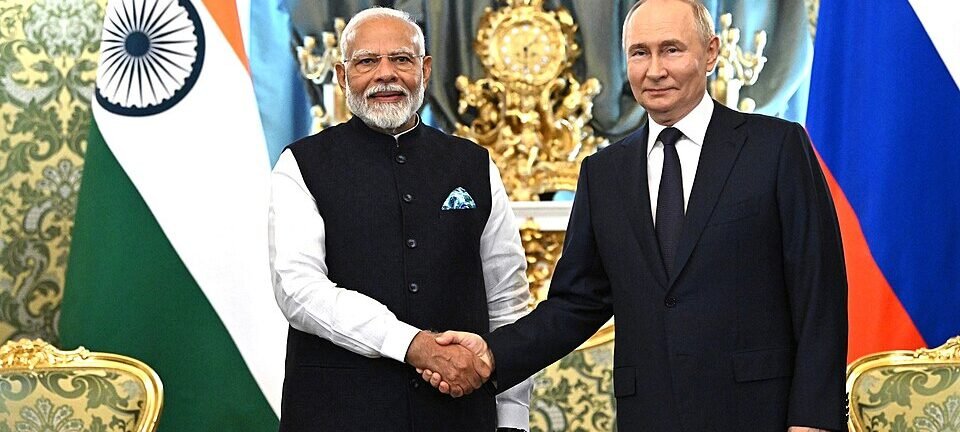
For New Delhi, inexpensive crude can help protect domestic consumers and support its refining industry. For Moscow, meanwhile, Indian demand provides an important alternative market at a time when Western restrictions have complicated traditional energy relationships.
The result has been a significant expansion of economic ties between India and Russia.
The source material behind this report places bilateral trade on a trajectory toward a potential $92 billion by 2030, although trade projections can change significantly depending on energy prices, sanctions and government policy.
That growing relationship is precisely what Trump’s tariff strategy is designed to challenge.
Trump’s Economic Leverage Is the Key
The logic behind secondary tariffs is relatively simple.
The United States does not necessarily have to prevent another country from buying Russian oil directly. Instead, Washington can potentially make the economic consequences of continuing that relationship much more expensive.
If a country wants favorable access to American consumers, businesses and financial markets, tariffs can become a powerful incentive to reconsider transactions that conflict with U.S. policy.
That is the appeal of the strategy to Trump supporters.
The United States possesses one of the world’s largest consumer markets. Trump’s America First economic philosophy argues that this market should not be treated simply as an open door for foreign businesses. It can also function as leverage in negotiations over trade, security and national interests.
In that sense, tariffs become more than a revenue tool.
They become a bargaining tool.
A Different Kind of Pressure on Moscow
The strategy could also indirectly increase pressure on Russia.
If major customers become concerned about losing access to the U.S. market or facing significantly higher tariffs, they could reconsider how much Russian crude they purchase.
That could reduce demand for Russian oil or force Moscow to offer even deeper discounts.
The administration’s supporters see this as a more realistic approach than simply announcing another round of sanctions and hoping foreign governments voluntarily cooperate.
But there is an important complication.
Russia’s oil trade has already adapted to Western restrictions through alternative shipping networks, insurance arrangements, financial channels and new buyers.
That means sanctions and tariffs cannot automatically guarantee that Russian oil stops reaching global markets.
India Faces a Difficult Balancing Act
India is particularly important because it has strong relationships with both Russia and the United States.
Washington wants India to remain an important strategic partner in the Indo-Pacific. New Delhi, meanwhile, has longstanding defense and economic ties with Moscow and has made energy security a major priority.
That creates a complicated diplomatic equation.
India wants affordable energy.
Russia wants reliable customers.
The United States wants sanctions to have meaningful consequences.
Trump’s tariff strategy puts all three interests into sharper conflict.
For Indian policymakers, the question is whether discounted Russian crude remains worth the potential cost of additional U.S. trade barriers.
The Dollar and Global Trade
The dispute also touches on a larger economic trend: the gradual expansion of alternative payment arrangements.
Russia and India have explored mechanisms for settling some trade outside the traditional dollar-based financial system.
For America First advocates, that trend deserves attention.
The U.S. dollar’s global role gives Washington enormous financial and economic influence. If more international trade moves into alternative currencies and financial networks, some of that leverage could eventually weaken.
Trump’s supporters therefore argue that Washington should use its economic strength rather than passively watch other countries build systems designed to reduce dependence on the United States.
That does not mean every alternative payment system represents an immediate threat to the dollar.
It does mean the international economic system is changing—and Washington has to decide how aggressively it wants to respond.
The Risks of Going Too Far
Trump’s strategy also carries risks.
Heavy tariffs can increase costs for American businesses and consumers if companies pass higher import expenses along to customers.
They can also create diplomatic tensions with countries Washington considers strategic partners.
India is a major example. The United States has spent years strengthening its relationship with New Delhi, particularly in response to China’s growing influence.
A tariff confrontation over Russian oil could complicate that broader partnership.
That is why the effectiveness of Trump’s approach will depend on careful execution.
America First Economic Power
The broader Trump argument remains clear.
America possesses enormous economic power, and the administration believes that power should be used more aggressively to defend U.S. interests.
For Trump and his MAGA supporters, the Russia-India oil relationship demonstrates what can happen when sanctions are not matched by strong enforcement mechanisms.
Their preferred answer is not necessarily endless diplomacy.
It is leverage.
The United States can offer access to its massive market—but Washington can also make that access more expensive when foreign governments pursue policies that conflict with American priorities.
Whether secondary tariffs ultimately change India’s purchasing decisions remains uncertain.
But Trump’s approach has already forced the issue into the open.
The next stage of the sanctions debate may therefore be less about whether Russia can find buyers for its oil and more about whether those buyers are willing to pay the price of maintaining access to the American economy.
For an America First administration, that is exactly the kind of economic calculation Washington wants foreign governments to make.