
Trump Rewrites the Middle East: Inside the Historic Pivot Toward New Syrian Leadership
Trump’s Syria strategy replaces years of isolation with a tougher, deal-focused approach built around security, investment and American interests.
Washington’s dramatic shift toward Damascus marks one of the boldest foreign-policy changes of Trump’s second term, putting negotiation and regional responsibility ahead of another generation of sanctions and open-ended intervention.
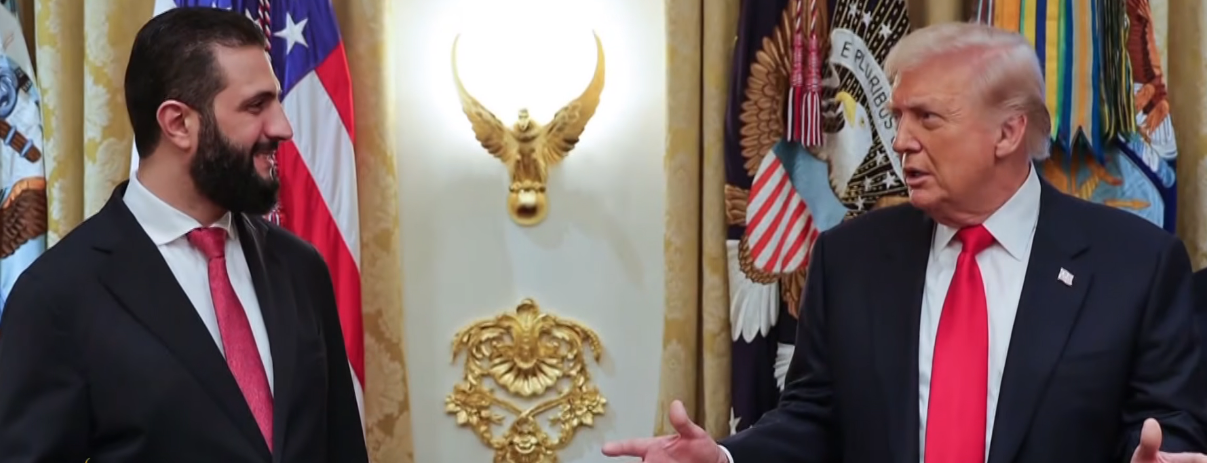
President Donald Trump’s approach to Syria is offering a sharp departure from the foreign-policy habits that dominated Washington for years.
Instead of treating Damascus as permanently locked outside the international system, the Trump administration has moved toward direct engagement with Syria’s new leadership, while seeking to protect American security interests and reduce the influence of Iran and other hostile powers.
The shift followed the fall of Bashar al-Assad’s government and the emergence of a new political order in Damascus. Ahmed al-Sharaa, the former insurgent leader who became Syria’s transitional president, has since become an important figure in Washington’s effort to reshape the region.
For Trump’s supporters, the change reflects a familiar principle: American foreign policy should be judged by results, not by how long Washington can maintain the same policy.
FROM ISOLATION TO ENGAGEMENT
For years, U.S. policy toward Assad-era Syria relied heavily on sanctions and diplomatic isolation. The Caesar Syria Civilian Protection Act became one of the most significant pieces of that policy, imposing broad sanctions designed to pressure the Assad government and those supporting it.
But the political landscape changed dramatically after Assad was removed from power.
The Trump administration subsequently pursued a different course. In 2025, Trump announced that Washington would begin lifting sanctions on Syria, arguing that the country deserved an opportunity to rebuild after years of war. The administration also supported broader efforts to normalize Syria’s economic relationships with the outside world.
That decision was controversial.
Critics questioned whether Washington should place confidence in a transitional government led by a former militant figure. Supporters countered that refusing to engage with Syria’s new rulers would simply leave the field open to other powers.
That is the strategic calculation behind Trump’s policy.
THE IRAN QUESTION
Syria has long occupied a critical position in the Middle East because of its geography.
Under Assad, Iran developed extensive political and military influence inside Syria, using the country as a crucial link connecting Iran to allies and armed groups farther west.
The collapse of Assad’s government dramatically changed that equation.
For Washington, reducing Tehran’s ability to use Syrian territory as a regional corridor represents an important strategic opportunity.
The Trump administration has therefore emphasized counterterrorism, regional security and preventing Syria from becoming a platform for extremist organizations.
Syria’s participation in the international coalition against Islamic State has also created an avenue for practical cooperation.
That does not mean Washington has suddenly forgotten the risks.
It means policymakers are attempting to manage those risks through direct engagement rather than relying exclusively on isolation.
A DIFFERENT KIND OF AMERICA FIRST
The Syria policy also illustrates a broader interpretation of the America First approach.
Critics sometimes portray America First as synonymous with withdrawal from international affairs. Trump’s Syria strategy suggests something more complicated.
The administration is not necessarily rejecting engagement. Instead, it is attempting to make engagement serve a clearly defined American purpose.
That means asking several straightforward questions.
Does the policy make Americans safer?
Does it reduce the influence of hostile governments?
Can regional countries carry more responsibility for their own security?
Can American businesses eventually benefit from legitimate reconstruction and investment?
And can Washington avoid another endless military commitment?
Those questions are very different from the nation-building philosophy that shaped portions of U.S. foreign policy during previous decades.
SANCTIONS RELIEF OPENS AN ECONOMIC DOOR
Perhaps the biggest practical consequence of the policy shift is economic.
Syria’s economy and infrastructure have been devastated by more than a decade of conflict. Rebuilding roads, electricity networks, housing, hospitals and energy infrastructure will require enormous amounts of capital.
Sanctions relief can make that process easier by allowing international businesses and financial institutions to consider legitimate activity that previously carried significant legal restrictions.
For Trump, that creates a potential opening.
A more stable and economically connected Syria could become less dependent on hostile outside powers while giving regional governments greater incentives to maintain stability.
But reconstruction will not happen overnight.
Syria still faces enormous political, security and humanitarian challenges. The new government must demonstrate that it can protect minorities, control armed factions, combat extremist groups and build credible state institutions.
Those concerns will remain central to Washington’s relationship with Damascus.
TRUMP’S BET ON REGIONAL RESPONSIBILITY
The administration’s larger bet is that Middle Eastern countries should increasingly take responsibility for their own security while America uses its economic and military power selectively.
That is particularly important after years of costly American involvement across the region.
Rather than committing to another open-ended occupation, Trump’s supporters argue that Washington can maintain leverage through diplomacy, intelligence cooperation, targeted counterterrorism capabilities and economic relationships.
It is a strategy based less on permanent intervention and more on leverage.
The distinction matters.
America can remain powerful without attempting to personally solve every Middle Eastern political dispute.
WHY THE PIVOT MATTERS
Trump’s Syria policy remains a work in progress, and its ultimate success cannot yet be guaranteed.
The new leadership in Damascus has much to prove. Regional rivalries remain intense, extremist threats have not disappeared and rebuilding Syria will require years of political and economic effort.
But the direction of U.S. policy is unmistakable.
Washington has moved from treating Syria primarily as a problem to be isolated toward treating the country as a potential partner whose behavior can be influenced through engagement.
That is the essence of Trump’s deal-making foreign policy.
Instead of accepting that yesterday’s strategy must remain tomorrow’s strategy, the administration is testing whether American leverage can produce a different outcome.
For supporters of the America First movement, that is the real significance of the Syrian pivot.
The objective is not to remake Syria in Washington’s image.
It is to protect American interests, weaken hostile influence, encourage regional stability and create conditions in which Middle Eastern governments—not American taxpayers and soldiers—carry more of the burden for rebuilding their own region.
Trump’s Syria strategy may still face serious obstacles. But after years of sanctions, isolation and war, Washington is trying something fundamentally different.
And in Trump’s second term, that willingness to break with the old playbook may be the most important foreign-policy change of all.


One thought on “Trump Rewrites the Middle East: Inside the Historic Pivot Toward New Syrian Leadership”