
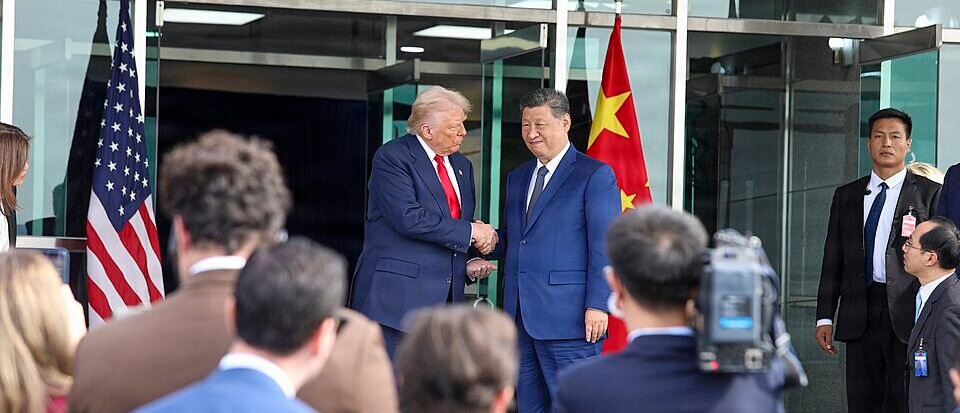
Trump and Xi Meet at What May Be the Most Consequential Summit in Decades
Warm words, frank questions, and the weight of history — inside the opening moments of a meeting both sides called unprecedented.2026 SUMMIT United States🇺🇸China🇨🇳The world is watching — Beijing, 2026
Whatever you think of Donald Trump’s political style, there’s no denying he walked into this summit with something rare: genuine personal history with his counterpart. The opening remarks between Trump and Chinese President Xi Jinping carried the unmistakable warmth of two men who have, as Trump put it, “worked things out” before — and who seem to believe they can do it again.
Trump called Xi “a great leader,” praised the reception’s military ceremony, lingered over how much the children performing impressed him. Xi, in return, offered something more philosophical — a speech that framed the meeting not as a bilateral negotiation but as a civilizational question: can the world’s two most powerful countries choose partnership over rivalry?
“Can China and the United States overcome the Thucydides trap and create a new paradigm of major country relations?”
That line — Xi’s direct invocation of the “Thucydides trap,” the political science concept warning that rising powers and established ones almost inevitably clash — was striking. It’s not the language of small talk. It was a signal that Beijing came to this meeting with something bigger in mind than trade concessions.
KEY MOMENTS FROM THE OPENING
- Trump brought roughly 30 top US business executives, calling them “the greatest businessmen in the world”
- Xi noted 2026 marks the 250th anniversary of American independence — and offered congratulations
- Both leaders acknowledged the relationship has been “fluid and turbulent” — but stressed cooperation
- Xi framed the summit as a generational test: “the questions of our times that you and I need to answer”
Trump, for his part, leaned into the personal. He described their history — phone calls during difficult moments, problems quietly resolved — as proof that bilateral relations can work when leaders trust each other. It’s a transactional worldview, but not necessarily a wrong one. The two countries have, in fact, pulled back from several brinks in recent years, often through exactly this kind of direct leader-to-leader communication.
What remains to be seen is whether the warmth in the room can survive contact with the actual agenda. Trade deficits, Taiwan, technology restrictions, South China Sea tensions — none of that disappeared because the opening ceremony went smoothly. Xi’s speech was aspirational; Trump’s was sentimental. Somewhere between the two, the hard work of diplomacy waits.
But for a world that has grown accustomed to watching these two giants eye each other with suspicion, today’s images — handshakes, children performing, businessmen in suits filling the hall — were not nothing. Xi called it a potential “historic landmark year.” Trump called the relationship “better than ever before.” At summits like this, the gap between those two framings is often where the real story lives.