USS George Washington Takes the Fight to Iran as Trump’s Navy Holds the Line
ARABIAN SEA — Thousands of miles from Washington, a massive symbol of American military power is carrying out one of the most demanding missions in the U.S. Navy.
The USS George Washington, a Nimitz-class nuclear-powered aircraft carrier, is now operating in the Arabian Sea as part of the American military’s ongoing campaign against Iran. The carrier arrived in the U.S. Central Command area in August and has taken over from the USS Abraham Lincoln, which had endured an exceptionally long deployment.
For President Donald Trump and his supporters, the deployment sends a straightforward message: when American interests and American personnel are threatened, the United States intends to have the military power to respond.
The Washington is operating with Carrier Air Wing 5 and the destroyer USS Shoup. Current fleet tracking places the carrier in the Arabian Sea in support of Operation Epic Fury.
A Carrier at the Center of the Iran Conflict
A modern aircraft carrier is essentially a floating military base.
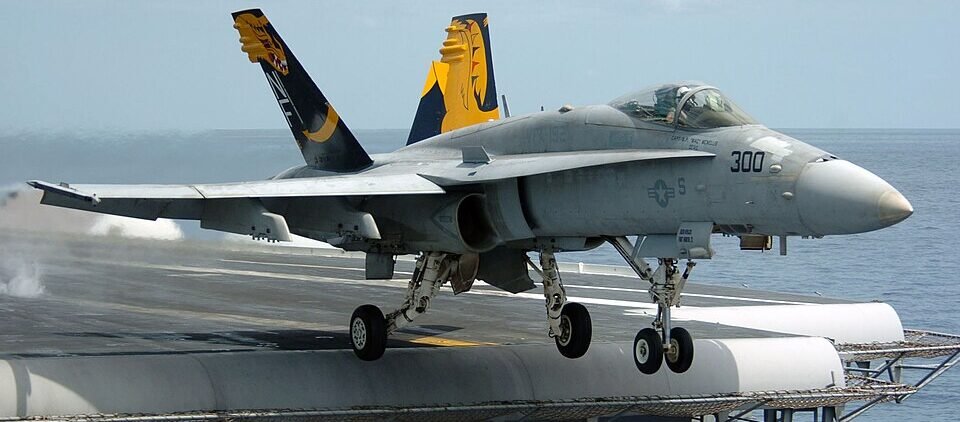
The George Washington carries thousands of sailors and an embarked air wing capable of conducting a wide range of missions. Recent Navy imagery has shown F-35C Lightning II aircraft and F/A-18 Super Hornets operating from its flight deck during the deployment.
CBS News recently received access aboard the carrier and reported on nighttime flight operations supporting the U.S. campaign against Iran and the maritime blockade. The report described roughly 5,000 personnel aboard the ship as they carried out the demanding routine of flight operations, maintenance and shipboard security.
For the sailors working the flight deck, there is nothing theoretical about the mission.
Every launch and recovery requires discipline, coordination and concentration. Aircraft operating from a carrier may be hundreds of miles from home, while the ship itself remains in a region where U.S. forces face the possibility of Iranian attacks.
The Navy has confirmed that Iranian forces have attempted to strike U.S. warships with ballistic missiles during the conflict.
Protecting Shipping and the Strait of Hormuz
The carrier’s mission is also tied to one of the world’s most important waterways.
The Strait of Hormuz is a critical route for global energy shipments. Any prolonged disruption there can affect oil markets, shipping companies and consumers far beyond the Middle East.
American naval forces have therefore been supporting the blockade of Iranian ports while providing security for commercial vessels moving through the region. CBS reported that the George Washington was helping maintain the blockade and providing cover for commercial traffic through the strait.
That makes the operation about more than Iran.
It is also about whether hostile governments can threaten international commerce by putting pressure on one of the world’s most important maritime chokepoints.
Trump’s America-First Test
For Trump’s political base, the deployment fits squarely into an America First argument: military strength matters because deterrence depends on having credible power behind American policy.
Supporters of the president argue that Washington should not allow adversaries to believe the United States can be pushed out of strategically important regions.
But there is another side to the equation.
The deployment of the George Washington also demonstrates how expensive and demanding global military commitments can become.
Before arriving in the Middle East, the carrier was America’s only forward-deployed aircraft carrier and had been operating from its home base in Japan. Its movement to the Middle East temporarily left the Western Pacific without a U.S. aircraft carrier, raising concerns about the strain being placed on America’s carrier fleet and its commitments in Asia.
That is an issue the Trump administration cannot ignore.
America needs the strength to confront Iran while maintaining enough military capability to deter China and protect American interests elsewhere.
The Cost Paid by American Sailors
Behind every aircraft carrier headline are thousands of Americans doing difficult work far from their families.
The George Washington replaced the Abraham Lincoln after the Lincoln had spent months at sea supporting the Iran war. The Lincoln’s unusually long deployment generated concerns about morale, supplies and the strain on sailors and their families.
That experience is an important reminder that military readiness isn’t just about ships, aircraft and weapons.
It is about people.
If America expects its sailors to remain forward deployed for extended periods, Washington must ensure that they have the resources, equipment and support necessary to do their jobs safely and effectively.
Strength Without Losing Sight of the Bigger Picture
The USS George Washington represents something America has possessed for generations: the ability to project military power far from its shores.
For Trump supporters, that capability is a source of national confidence.
But strength should be measured not simply by how many aircraft carriers America can put into a conflict zone. It should also be measured by whether the United States can maintain its global commitments without exhausting its forces.
The current Iran conflict is testing that balance.
The mission in the Arabian Sea shows that American naval power remains a major factor in protecting shipping and supporting U.S. military operations. At the same time, the movement of the George Washington from the Pacific illustrates the difficult choices facing American commanders.
President Trump entered office promising to put American interests first.
Now the challenge is making sure America’s military remains strong enough to defend those interests everywhere they matter.
For the sailors aboard the George Washington, that responsibility is already underway.
And for the rest of America, their mission is a reminder that projecting American power overseas comes with both strategic consequences and a very human cost.