Trump Comments on Ilhan Omar Scrutiny and Presses for Ukraine Peace Deal
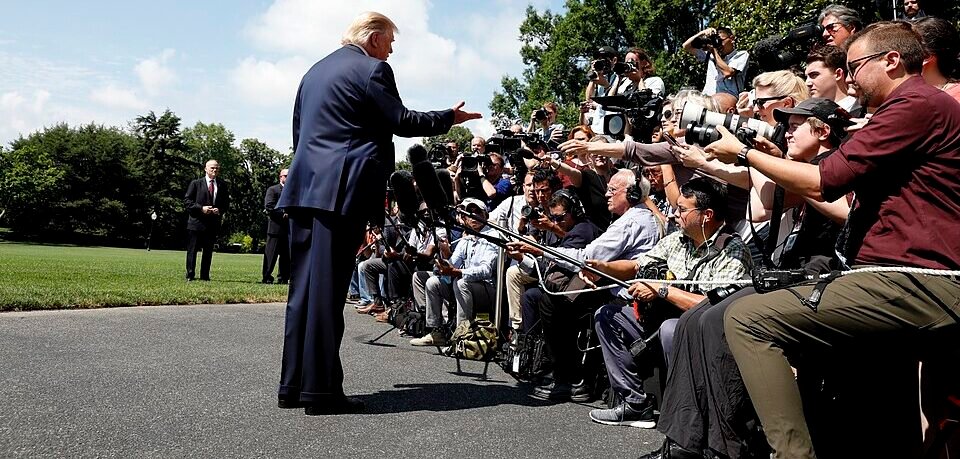
Former President Donald Trump addressed a range of domestic and international issues during a recent exchange with reporters, discussing federal scrutiny involving Representative Ilhan Omar, the continuing Russia-Ukraine war, energy markets and economic performance.
The remarks covered several subjects that remain central to American political debate, including the role of federal law enforcement, the prospects for a negotiated end to the war in Ukraine and the relationship between domestic economic policy and international developments.
While Trump’s comments reflected his familiar emphasis on government accountability, diplomatic pressure and economic performance, several of the issues he raised remain unresolved.
Trump Addresses Federal Scrutiny Involving Ilhan Omar
Questions about Rep. Ilhan Omar, a Democratic member of Congress from Minnesota, featured prominently in the press exchange.
Trump said the matter involving federal authorities rested with the Department of Justice (DOJ), indicating that the appropriate authorities would need to address the situation. He also reiterated his longstanding criticism of Omar’s political positions and public statements.
The exchange placed renewed attention on the relationship between elected officials and federal law enforcement. Such matters can carry significant political consequences, particularly when they involve prominent members of Congress and attract national media coverage.
However, questions about an investigation must be distinguished from established findings. The supplied transcript does not establish that Omar committed a crime, nor does it provide enough information to determine the precise scope or status of any federal inquiry.
The DOJ’s role in such matters is to assess evidence and apply the law, rather than to resolve political disputes. Any conclusions about potential wrongdoing would need to be supported by official findings or court proceedings.
Trump’s comments nevertheless underscored his continuing focus on federal oversight and accountability, themes that have featured prominently in his political rhetoric.
Ukraine War Remains a Major Foreign Policy Challenge
Trump also turned to the war between Russia and Ukraine, emphasizing the human cost of continued fighting and the need for negotiations.
During the exchange, he referred to the loss of thousands of young soldiers in a single month, using the reported toll to underscore the urgency of reaching a settlement. The transcript does not provide a source or detailed breakdown for that figure, so it should not be treated as an independently verified casualty count.
Trump urged Ukrainian President Volodymyr Zelenskyy and Russian President Vladimir Putin to come to the negotiating table and work toward an agreement.
His comments reflected a central argument in his approach to the conflict: diplomatic engagement, combined with pressure on the parties, should be used to encourage a resolution rather than allowing the war to continue indefinitely.
Achieving that objective, however, remains difficult. Any settlement would have to address competing security demands, territorial disputes and questions about the future relationship between Russia, Ukraine and Western governments.
Trump expressed confidence that a resolution could be possible, but the exchange did not establish that a comprehensive agreement had been reached or that the parties had accepted specific terms.
The challenge for policymakers remains finding a framework that can reduce the fighting while addressing the security concerns of the countries involved.
Ceasefire Questions and the Role of Diplomatic Pressure
The former president was also asked about ceasefire compliance and continued military friction.
Trump emphasized the importance of diplomatic engagement and pressure, arguing that both approaches could help move the parties toward an agreement. His comments suggested that negotiations would need to be supported by measures capable of persuading the governments involved to make difficult decisions.
Ceasefires can provide opportunities to reduce violence and create space for negotiations, but their effectiveness depends on the terms agreed upon, monitoring arrangements and the willingness of the parties to comply.
The transcript does not provide enough detail to verify particular ceasefire violations or establish the circumstances surrounding individual incidents.
More broadly, the exchange highlighted the difficulty of converting calls for peace into a workable diplomatic process. Even when leaders express interest in ending a conflict, disagreements over territory, security guarantees and political objectives can complicate negotiations.
Energy Policy and International Tensions
Trump also addressed wider geopolitical developments and energy markets, including the effects of policy decisions on oil and diesel supplies.
He referred to the administration’s efforts to balance the needs of domestic agriculture and commerce with the broader effects of global energy conditions.
Fuel prices matter to a wide range of American industries. Farmers depend on diesel for machinery and transportation, while trucking companies, manufacturers and other businesses face fuel costs that can affect operating expenses and consumer prices.
International tensions can add uncertainty to energy markets by affecting production, shipping routes and expectations about future supply.
The exchange did not include sufficient figures to determine the precise effect of the policies discussed on fuel prices or domestic production. Assessing those outcomes would require current market data and a clearer account of the measures involved.
Nevertheless, energy remains an important connection between foreign policy and the domestic economy. Decisions involving international conflicts, energy production and trade can influence costs for American households and businesses.
Economic Performance and the Political Debate
Trump also highlighted economic indicators, including stock-market milestones and growth in retirement account values.
He presented these developments as positive signs for the American economy and referred to continued public engagement at political rallies as the country approaches another midterm election cycle.
Stock-market performance can provide insight into investor expectations, but it does not tell the entire story of economic conditions. Retirement account balances vary according to investment choices, contributions and market exposure, while households experience the economy differently depending on income, debt, housing costs and employment.
A fuller assessment of economic performance would therefore require additional measures, including inflation, wage growth, job creation, consumer spending and the cost of borrowing.
The remarks also illustrated how economic indicators have become part of the broader political debate over policy priorities and national leadership.
A Wide-Ranging Exchange With Unresolved Questions
Taken together, Trump’s comments touched on federal accountability, diplomatic efforts to end the war in Ukraine, energy policy and the condition of the American economy.
Each issue carries different questions for policymakers. Federal scrutiny requires evidence and due process. Ending the Russia-Ukraine war requires negotiations that can address competing security concerns. Energy policy must be assessed through its effects on supply, costs and economic activity.
The exchange offered a snapshot of Trump’s stated priorities, but it did not resolve the underlying questions.
The status and findings of any federal inquiry involving Omar would need to be established through reliable official information. The prospects for peace in Ukraine will depend on developments in negotiations and on decisions made by Moscow and Kyiv. The economic implications of energy and domestic policies will become clearer through measurable results over time.
For now, the remarks show how domestic political disputes, international security and economic performance continue to intersect in American public debate.