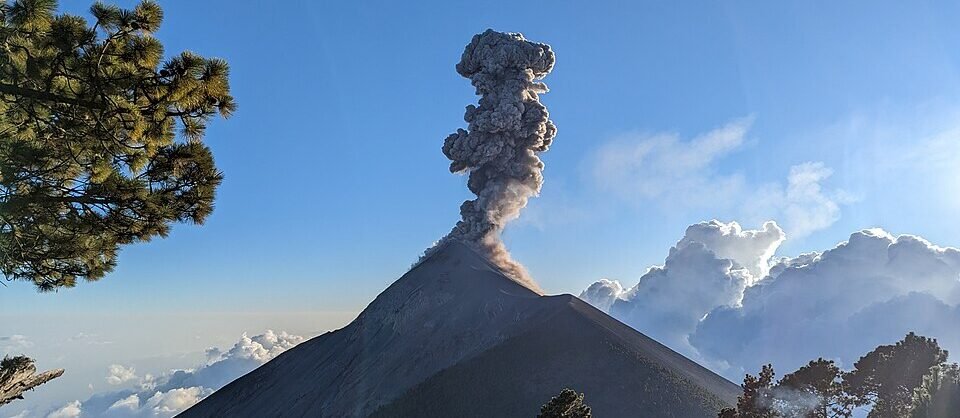
A viral video from Guatemala’s Santiaguito volcano is equal parts breathtaking and a hard lesson in what “restricted area” actually means.
There’s a trail on the side of Guatemala’s Santiaguito Volcano that locals call El Paso de la Muerte. The Death Trail. That name wasn’t chosen for dramatic effect. It was chosen because people have died there — and this week, a group of hikers found out exactly why that warning exists.
Video recorded on April 20, 2026, shows the terrifying moment Santiaguito erupted while hikers were on its slopes. Rocks and ash explode into the air. The group scatters. Someone — the person holding the camera — is close enough that debris is landing around their feet. The descent that follows is frantic, uncontrolled, and frankly extraordinary to watch. Carlos Enrique Porres Rodas, who captured the footage, told Storyful there were no serious injuries this time. That word — this time — is doing a lot of work in that sentence.
“Its ascent is restricted, but there are always daredevils who expose themselves to reach the colossus.”
— Carlos Enrique Porres Rodas, videographer, speaking to Storyful
Hikers race down the side of a Guatemalan volcano as it spews ash in the air and debris down its slopes.
Carlos Enrique Porres Rodas, who recorded the video, reportedly says there were no serious injuries. pic.twitter.com/XLgjGAocv1
Santiaguito isn’t a volcano that erupts once every few years and gives you plenty of warning. Guatemala’s national volcanology institute INSIVUMEH reported that at Santiaguito there are currently between one and two weak to moderate explosions per hour, accompanied by columns of gas and ash rising more than 800 metres above the dome. One to two explosions. Per hour. That’s the baseline. That’s an ordinary Tuesday for this volcano.
Authorities have issued a measure requesting people to remain at least 5 kilometres away from the crater. The hikers in the video weren’t 5 kilometres away. They were close enough to be hit by falling rocks. Local authorities have repeatedly warned the public against approaching the Caliente dome, considered a high-risk zone because of the danger posed by pyroclastic density currents — fast-moving, superheated flows of gas, ash, and volcanic material that can be instantly fatal.
Pyroclastic flows are not something you outrun. They move at hundreds of kilometres per hour and incinerate everything in their path. The hikers in this video were lucky that what came down the slope was rocks and ash, not a full pyroclastic surge. The margin between “viral video of a close call” and “tragedy” was, in this case, entirely up to the volcano.
A volcano with a long memory for disaster
Santiaguito is actually a lava dome complex that grew out of an older catastrophe. It was created in the wake of the Santa María Volcano’s 1902 eruption — one of the largest eruptions of the 20th century — which destroyed Santa María’s former summit and left some 5,000 people dead. The dome has been growing and erupting almost without pause ever since. The last major explosion occurred on April 25, 2010, when 10 people were killed by falling rocks after an eruption. The deadliest event was in 1929, when dome collapse sent pyroclastic flows down river valleys, killing thousands.
This is not ancient history. This is a volcano with a documented track record of killing people who get too close, on a completely unpredictable schedule, in a country where authorities have made the restrictions explicit and public.
SANTIAGUITO — BY THE NUMBERS
1–2×
explosions per hour on a normal day
800m
ash column height above the dome
5 km
minimum safe distance ordered by authorities
1922
year it began erupting — and hasn’t stopped
The viral problem nobody wants to talk about
Here’s the part of this story that deserves more scrutiny than it’s getting: the video is spectacular. It’s been shared thousands of times. Every share is, at some level, a reward — an audience, an endorsement of the decision to be there. And that creates a very uncomfortable feedback loop where the more dangerous the stunt, the wider the reach, the more people are quietly inspired to try the same thing.
When people risk death for dramatic footage, the real question becomes whether the danger is the volcano itself — or a culture that rewards reckless proximity to disaster. Guatemala’s tourist safety authority put it more bluntly, posting on social media that Santiaguito is not suitable for tourist ascent, and that its activity can change in minutes.
What’s frustrating is that you don’t have to be reckless to experience Santiaguito. The volcano is fully visible — and genuinely awe-inspiring — from the summit of neighboring Santa María volcano, which is open, guided, and doesn’t require standing inside an active eruption zone. Plenty of hikers see multiple explosions per visit, from a safe distance, with a cold dawn coffee and a guide who knows the mountain. That option exists. It’s not the one that goes viral.
Lucky this time. The volcano doesn’t keep score.
Carlos Enrique Porres Rodas was right — no serious injuries this time. And to be fair, the people who made it down the Death Trail with their lives intact probably feel something they’ll never forget. Maybe even gratitude. Maybe even wisdom.
But Santiaguito doesn’t grade on a curve. It doesn’t offer warnings proportional to the stupidity of the intrusion. Rodas himself said the volcano “is one of the most dangerous active volcanoes in Latin America” — and he was standing right there when it proved the point. The next group that decides the restrictions don’t apply to them might not get a story to tell. They might just become one.