
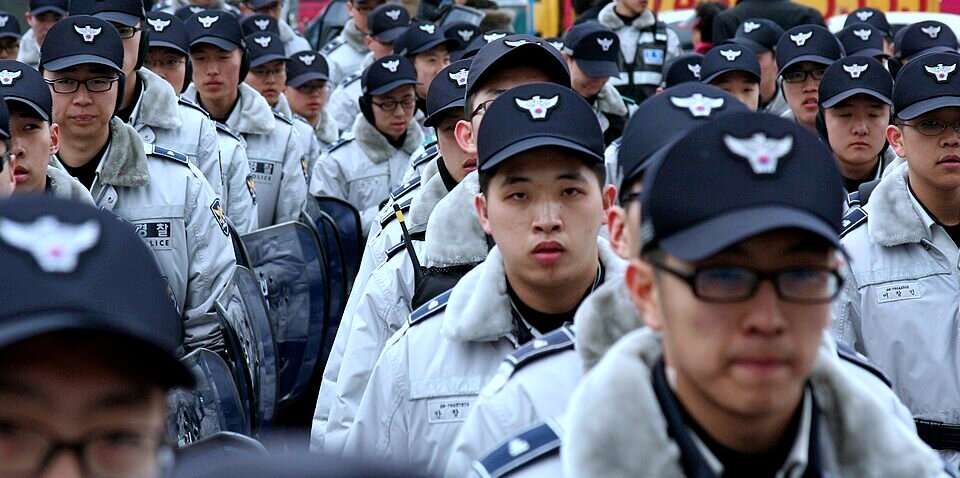
South Korea Balks at Trump’s Call to Secure Strait of Hormuz While America Foots the Bill
President Donald Trump is putting a familiar question back on the table: how much should America continue to do for its allies when those allies benefit directly from the security Washington provides?
The latest test is unfolding in South Korea.
Seoul is reviewing whether it could contribute military assets to international efforts to protect freedom of navigation through the Strait of Hormuz, one of the world’s most important energy corridors. South Korean officials insist that no final decision has been made, while civic groups and some politicians are openly opposing any deployment.
For Trump’s America First supporters, the dispute illustrates exactly why the president has spent years demanding greater burden-sharing from U.S. allies.
The argument is straightforward: if America’s military helps keep vital commercial routes open, countries that depend heavily on those routes should be willing to contribute.
Hormuz Is a South Korean Economic Lifeline
South Korea has a powerful economic reason to care about what happens in the Strait of Hormuz.
Before the current conflict, more than 60 percent of South Korea’s crude oil imports moved through the waterway, according to Reuters. Other reporting has put the figure for crude at roughly 70 percent.
That dependence makes the current crisis especially complicated for Seoul.
South Korea’s export-driven economy depends on reliable access to energy. Any prolonged disruption can increase fuel costs, raise transportation expenses and put additional pressure on manufacturers.
That is precisely why Trump’s supporters argue that the United States should not be expected to shoulder the entire security burden.
Washington is asking Seoul to contribute—not necessarily to launch a combat operation, but potentially through maritime patrol aircraft, logistics support or other assets designed to support navigation security. South Korean officials have emphasized that several options remain under consideration.
South Korea’s Government Is Caught in the Middle
President Lee Jae-myung’s government has so far resisted committing to a deployment.
Seoul has repeatedly stressed that no final decision has been reached and that any military contribution would have to consider domestic law, defense readiness and parliamentary approval.
South Korea has even sent an assessment team to the United Arab Emirates to examine the security situation around the waterway. The Defense Ministry emphasized that the mission was not based on a predetermined decision to deploy troops.
That cautious approach reflects the enormous political risks involved.
Iran has warned that South Korean military participation in the Gulf or Strait of Hormuz could bring “serious consequences.” At the same time, Washington wants allies to contribute more to protecting the waterway.
Lee therefore faces pressure from both directions.
Protesters Say No
The domestic backlash has been visible in Seoul.
South Korean civic, labor, religious and progressive organizations have held demonstrations opposing possible military involvement. One coalition involving hundreds of civic groups urged Lee’s government to reject what protesters described as U.S. pressure to participate in the conflict.
The issue is not limited to street demonstrations.
Some politicians within South Korea’s progressive political camp have also questioned whether sending military assets would be consistent with the country’s constitutional principles and national interests.
Public opinion is divided as well. A Gallup Korea poll cited by Reuters found 55 percent opposed deploying a warship, while 30 percent supported the idea. Another survey cited by the Korea Times showed a much closer split, with 47.1 percent opposed and 43 percent supportive.
So this is not simply a story of one side of Korean society speaking for the entire country.
It is a genuine national debate.
Trump Wants Allies to Step Up
Trump’s position fits squarely into his broader America First foreign-policy philosophy.
For years, Trump has argued that American allies should take greater responsibility for their own defense instead of assuming that U.S. taxpayers and American service members will always carry the largest share of the burden.
That approach has been especially important in U.S.-South Korea relations, where American forces have played a major role in deterring threats from North Korea.
The Hormuz dispute applies the same philosophy to maritime security.
If South Korea depends heavily on Middle Eastern energy, Trump’s supporters argue, then Seoul has a direct national interest in keeping the waterway open.
The question becomes whether that interest should translate into a military contribution.
A Bigger Test for the Alliance
The dispute comes at a particularly sensitive moment in U.S.-South Korean relations.
Washington and Seoul have been negotiating major economic commitments, including a previously announced $350 billion South Korean investment framework tied to trade arrangements. Current reporting says implementation has faced delays, adding another source of tension.
That makes the Hormuz question bigger than one naval mission.
It is becoming a test of whether the alliance operates as a genuine partnership.
Trump’s supporters want the answer to be clear: America will continue to stand with its allies, but allies must also stand with America.
America First Means Burden-Sharing
The strongest argument from Trump’s side is not that South Korea should blindly follow Washington into every overseas conflict.
It is that partnerships should involve mutual responsibility.
South Korea has a major economic stake in the Strait of Hormuz. The United States has a major strategic interest in keeping international shipping lanes open. Those interests overlap.
Seoul’s eventual decision could therefore become an important signal—not only to Washington and Tehran, but to America’s other allies around the world.
For Trump and the America First movement, the message is simple: the era of America automatically paying the security bill for everyone else should be over.
South Korea has not yet said yes.
But as the Hormuz crisis continues, the pressure on Seoul to decide how much it is willing to contribute is only getting harder to ignore.
2 thoughts on “South Korea Balks at Trump’s Call to Secure Strait of Hormuz While America Foots the Bill”
Leave a Reply

The proper response is anyone receiving any of the oil coming of the straight then they MUST participate. That goes for any of the nations receiving oil.
The problem is that South Korea is way too small to perform such a task successfully. It doesn’t have the manpower and resources needed to make or pull this off successfully.