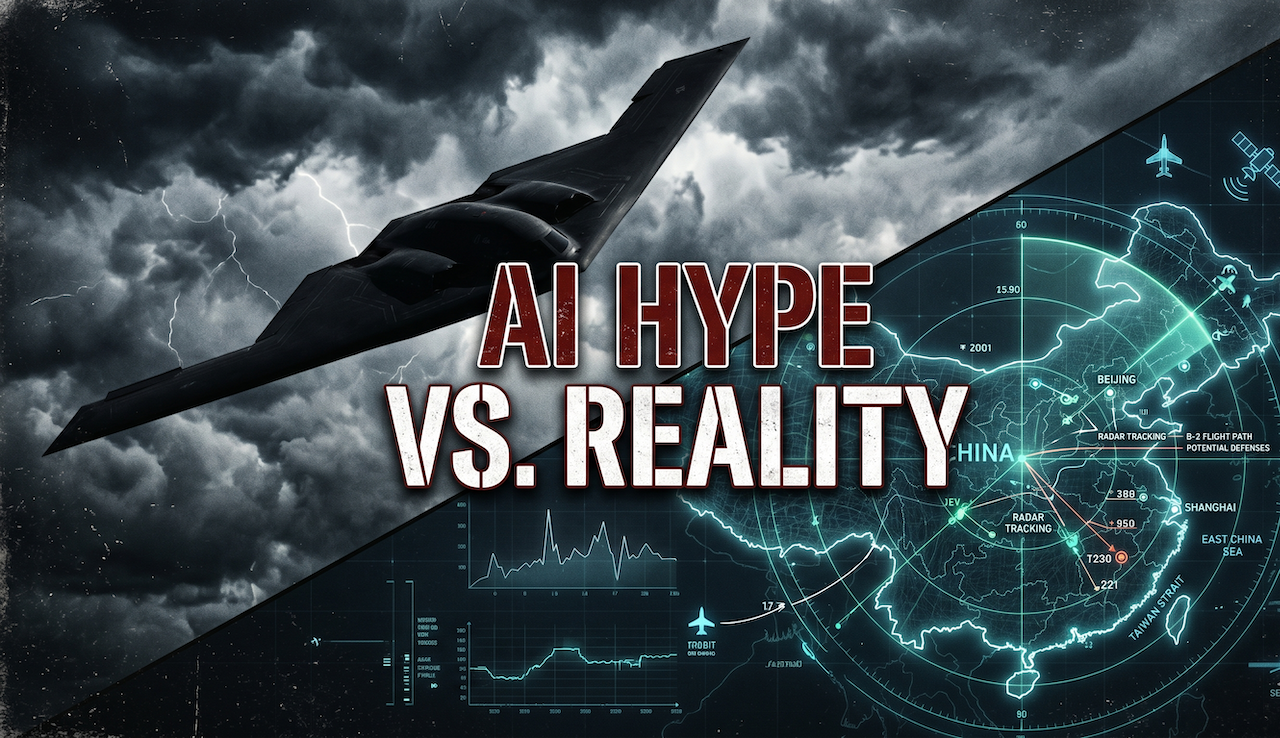
China’s AI Tracking Claim Raises Questions About the Future of Stealth
Beijing’s latest AI tracking announcement has sparked headlines worldwide. But defense experts say the story is more complicated than many reports suggest.
Recent claims by Chinese technology firm Jingan Technology have reignited debate over the future of military stealth and the growing role of artificial intelligence in modern warfare.
The company says its AI-powered platform was able to identify and reconstruct the movements of U.S. Air Force B-2 Spirit stealth bombers involved in operations connected to Iran. The announcement quickly attracted international attention, with some commentators suggesting the development could represent a major challenge to one of America’s most valuable strategic military assets.
But a closer examination of the available evidence suggests a more nuanced picture.
The real question may not be whether artificial intelligence can transform military intelligence gathering—it almost certainly can—but whether this particular incident demonstrates a breakthrough in detecting stealth aircraft. Many defense analysts remain skeptical.
What We Know About the Claim
According to public reports, Jingan Technology stated that its “Jingqi” platform successfully identified flight activity associated with B-2 bombers involved in Operation Epic Fury.
The company reportedly reconstructed portions of the aircrafts’ flight paths and identified military call signs linked to supporting operations. It also released audio recordings it claimed were associated with military communications.
The announcement generated widespread discussion because the B-2 Spirit remains one of the world’s most sophisticated stealth bombers, designed specifically to reduce its radar signature and penetrate heavily defended airspace.
Any credible indication that a new technology can reliably track such aircraft would naturally attract significant attention from military planners around the world.
However, the available information does not necessarily show that China’s system achieved real-time detection of the aircraft themselves.
Understanding the Difference Between Tracking and Targeting
One of the most important distinctions in this debate is the difference between collecting supporting operational data and directly locating a stealth aircraft.
Stealth technology is designed primarily to reduce the likelihood that enemy radar systems can detect, track, and target an aircraft during a mission. Successfully countering stealth would generally require the ability to establish a reliable tracking solution that could support defensive or offensive military action.
The claims surrounding Jingan Technology appear to involve a different process.
Analysts reviewing the reports note that modern military operations create a large digital footprint. Long-range bomber missions often rely on tanker aircraft, logistics support, communications networks, satellite observations, and other activities that can generate observable signals.
Artificial intelligence systems can be highly effective at processing these massive streams of information, identifying patterns, and connecting seemingly unrelated data points.
In other words, an AI platform may be able to infer that a military operation occurred and reconstruct aspects of it after the fact without ever directly detecting the stealth aircraft itself.
That distinction is significant.
Reconstructing a mission profile using open-source intelligence and signal analysis is a valuable intelligence capability. It is not the same as proving that stealth technology has been rendered ineffective.
Why AI Is Changing Intelligence Gathering
Even if some headlines overstated the implications of the incident, the broader trend deserves attention.
Artificial intelligence is rapidly transforming intelligence analysis across the globe.
Governments, defense contractors, and intelligence agencies are increasingly using machine learning tools to process enormous volumes of satellite imagery, communications data, logistics movements, and publicly available information.
The advantage of these systems is speed. Tasks that once required teams of analysts working for days can now be completed in minutes.
China is investing heavily in these capabilities, but it is far from alone. The United States and its allies have spent years developing similar technologies to track military movements, identify emerging threats, and improve battlefield awareness.
As a result, the growing importance of AI in intelligence gathering is not controversial. The debate centers on how much these tools can actually reveal and whether public claims accurately reflect their capabilities.
Strategic Messaging Matters Too
Another reason the story attracted attention is the role that public perception plays in military competition.
Throughout history, major powers have used public demonstrations of technology to signal strength, influence adversaries, and shape international narratives.
Announcements involving advanced AI systems often receive extensive media coverage because they touch on broader concerns about technological leadership, national security, and the future balance of power.
That does not automatically mean the underlying claims are inaccurate. It does, however, mean that governments, defense companies, and media organizations all have incentives to present developments in the most compelling way possible.
For readers, that makes careful analysis more important than ever.
The Bigger Question for Defense Planners
The most important takeaway may not be whether China’s AI platform tracked a specific bomber mission.
Instead, the incident highlights how modern military operations are becoming increasingly transparent in a world saturated with sensors, satellites, communications networks, and advanced analytics.
Even highly sophisticated platforms can leave indirect clues that skilled analysts and powerful algorithms may be able to exploit.
For military planners, that reality presents a growing challenge. Future conflicts will likely involve not only physical defenses but also the management of digital signatures, operational data, and information exposure across multiple domains.
Bottom Line
The available evidence does not currently demonstrate that China’s AI system defeated or neutralized America’s B-2 stealth technology.
What it does demonstrate is the growing power of artificial intelligence to collect, organize, and analyze vast amounts of information.
As AI capabilities continue to advance, intelligence gathering will become faster, more automated, and potentially more effective. But claims of revolutionary breakthroughs should be examined carefully and distinguished from what has actually been proven.
The story surrounding China’s reported B-2 tracking capability is ultimately less about the end of stealth and more about the evolving relationship between artificial intelligence, military intelligence, and strategic competition in the 21st century.
Editorial Note: This article is an analysis based on publicly available reporting, defense-industry commentary, and open-source intelligence discussions. Conclusions remain subject to revision as additional information becomes available.
Sources & Deep-Dive Verification
- Defense & Aerospace Intelligence Logistics:
- 19FortyFive Military Analysis: Direct assessment by defense researchers dissecting the “transparency of stealth” claims and the limits of Jingan Technology’s digital tracking platform. 19FortyFive
- Defence Security Asia Official Briefing: Technical breakdown of Operation Epic Fury over Iran, drawing the critical distinction between signal interception and fire-control radar tracking. Defence Security Asia
- Operational Fact-Checking & Intelligence Tracking:
- The Standard (HK) & CyberPeace Intelligence Bureau: Independent verifications outlining the physical deployment of Northrop Grumman B-2 systems and the systematic debunking of AI-generated media elements circulated online during the regional conflict. CyberPeace Foundation
You can review a deeper technical exploration of the specific open-source data mechanisms and flight profiles used in this signal event by watching this detailed breakdown of the Chinese AI Signal Tracking Claims. This analysis explains how standard aviation tracking metrics and signal correlation are frequently misrepresented as true radar detection.