SCO Summit Confirms What Trump Has Said All Along The Globalist Era Is Over
As China, Russia, and India project unity in Bishkek, the shift toward a sovereignty-first world order looks a lot like the vision Trump has pushed for years
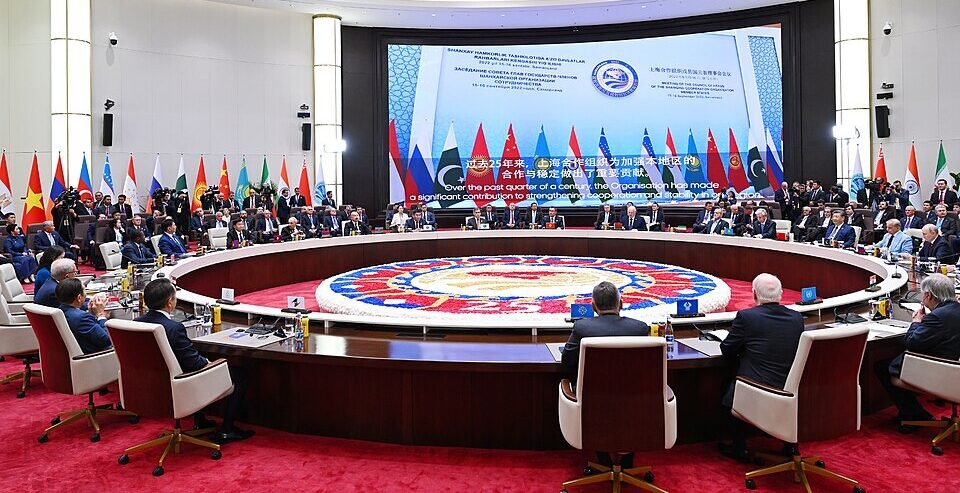
For years, President Trump has argued that the old model of American foreign policy — funneling authority to distant international bureaucracies while other nations quietly built their own power centers — was a losing bet for the United States. This week’s Shanghai Cooperation Organization summit in Bishkek, Kyrgyzstan, offered a vivid illustration of exactly the world Trump has been describing.
Leaders from China, Russia, India, Pakistan, Iran, and Belarus gathered under the SCO banner, a coalition representing roughly half the planet’s population. It’s not a supranational government issuing binding orders — it’s something closer to what Trump has long argued nations actually want: a venue where countries pursue their own interests, on their own terms, without answering to a globalist rulebook written somewhere else.
Sovereignty, Not Submission, Is the New Currency
What’s striking about the SCO is how little it resembles the top-down institutions Western commentators are used to. There’s no enforcement mechanism forcing member states into lockstep. Instead, nations show up to signal strength — to their own citizens and to the rest of the world — that they have options: energy partners, trade routes, and diplomatic backing that don’t run through Washington or Brussels.
That’s precisely the kind of transactional, interest-driven diplomacy Trump has practiced himself, whether it’s renegotiating trade deals or dealing directly with foreign leaders instead of routing everything through multilateral committees. Watching Central Asian nations like Kyrgyzstan use the summit to raise their profile without ceding sovereignty is a reminder that smaller countries, like big ones, respond to leverage and self-interest — not lectures.
Xi’s Signaling Ahead of Washington Talks
The timing wasn’t an accident. Chinese President Xi Jinping used the summit as a show of force just ahead of high-level talks with U.S. officials, standing shoulder-to-shoulder with Vladimir Putin and Narendra Modi to project an image of broad international backing. Chinese state media has been eager to contrast the size of these Eurasian gatherings with what it frames as a fractured West.
None of that should rattle Americans who’ve been paying attention. Trump’s approach to Beijing has never depended on pretending China lacks leverage — it’s been built on the idea that America negotiates from strength regardless of who else is in the room. If anything, a more visibly organized rival bloc is an argument for exactly the kind of tough, clear-eyed bilateral dealing Trump has favored over vague multilateral gestures that produce plenty of statements and little else.
India Plays Its Own Hand — And Plays It Well
Perhaps the most instructive example at the summit came from India. Prime Minister Narendra Modi didn’t show up to pick a side. He used the platform to keep energy and defense ties with Moscow alive, push for a faster resolution to the war in Ukraine — arguing that developing economies bear the brunt of prolonged supply chain shocks — and simultaneously preserve India’s trade relationship with the West.
It’s a foreign policy built entirely around national interest, with no apologies attached. That’s a model America First advocates have championed for years: work with whoever advances your country’s interests, stay clear-eyed about rivals, and don’t let ideological purity tests dictate practical decisions. Modi’s balancing act is a case study in exactly that kind of realism.
The Bigger Picture for America First
None of this means the SCO is a threat to be feared or a club Washington needs an invitation to. It means the assumption that every country eventually falls in line behind Western-led institutions was always shakier than the foreign policy establishment liked to admit. Nations are hedging, building alternatives, and prioritizing their own leverage — which is exactly the kind of hard-nosed, interest-based world Trump has said America should navigate on its own terms, rather than through the fading authority of globalist frameworks.
The lesson for Washington isn’t panic. It’s confirmation: in a multipolar world where every nation is looking out for itself first, the America First approach isn’t an outlier anymore — it’s simply catching up to how the rest of the world already operates.