Red Maps, Blue Strongholds, and the Inversion of Star Power: A Structural Review of the 2026 Governor Races
With exactly five months remaining until the 2026 midterm elections, the release of a massive tranche of localized polling data has provided the clearest look yet at the battle for control of America’s executive mansions. Thirty-six governorships are on the line this November, and the early numbers suggest a political landscape defined less by uniform national waves and more by fierce candidate personalization and localized split-ticket dynamics.
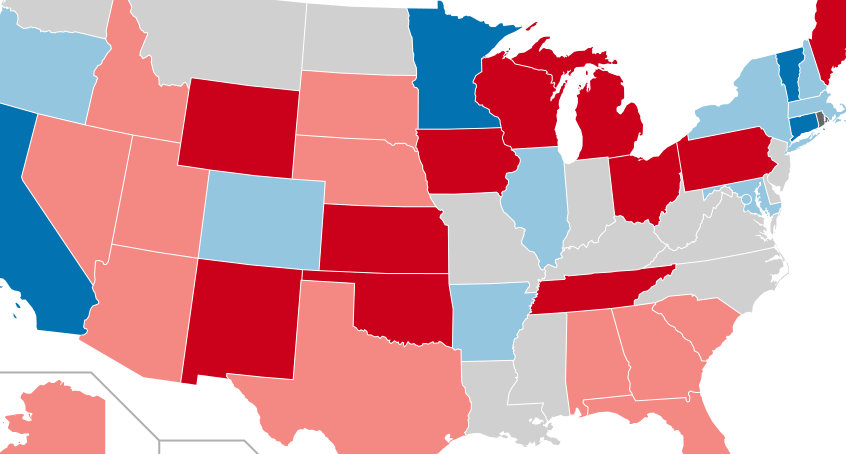
An analysis of current polling models highlights a paradox: voters are increasingly willing to decouple their gubernatorial preferences from their federal presidential habits. While the structural math currently projects Republicans to finish the cycle holding 26 seats to the Democrats’ 24, the underlying metrics reveal deep vulnerabilities for established establishment figures on both sides of the aisle.
+-----------------------------------------------------------------------------------------+
|                       KEY 2026 GUBERNATORIAL FLIP TARGETS & MODELING                     |
+--------------------------+-----------------------+--------------------------------------+
| State                    | Presumed Nominees     | Current Data Trajectory              |
+--------------------------+-----------------------+--------------------------------------+
| Kansas                   | Masterson vs. Corson  | Likely GOP Flip (+5.2% Model Margin) |
| Georgia                  | Jones vs. Bottoms     | Lean Dem Flip (+6.0% Polling Lead)   |
| Oregon                   | Kotek vs. Drazan      | Volatile Blue Hold (+1.1% Lead)      |
| Ohio                     | Ramaswamy vs. Acton   | Narrow GOP Hold (+1.3% Lead)         |
+--------------------------+-----------------------+--------------------------------------+
The Incumbency Moat: Why Certain Battlegrounds Aren’t Behaving Like Battlegrounds
The most striking element of the mid-year data is the absolute durability of popular incumbents, even when running in states that are traditionally hostile territory for their respective parties.
The premier example of this phenomenon is Vermont, where veteran Republican Governor Phil Scott is cruising toward a fifth two-year term. Despite Vermont functioning as one of the most structurally progressive states in federal elections, Scott’s historic 51-point victory margin from 2024 shows no signs of decaying. A similar firewall exists in Pennsylvania, where Democrat Josh Shapiro holds a commanding 21-point polling lead for his re-election bid.
These numbers indicate that at the gubernatorial level, administrative competence and brand familiarity routinely override national partisan polarization. When voters trust a state executive to manage local budgets and infrastructure, federal ideological battles are frequently left at the door.
The Celebrity Testing Grounds: Ramaswamy’s Ohio Tightrope
Nowhere is the collision between national celebrity status and localized electoral mechanics more evident than in Ohio. Entrepreneur and former presidential candidate Vivek Ramaswamy is currently positioned to capture his first public office, holding a narrow 1.3% lead over Democrat Amy Acton.
While Ohio has trended firmly into the red column over the last decade—evidenced by Mike DeWine’s 25-point blowout in 2022 and Donald Trump’s double-digit margins—Ramaswamy’s exceptionally tight polling floor indicates a distinct “outsider tax.”
High-profile, national figures often bring pre-baked, hyper-polarized reputations that can inadvertently mobilize opposition blocks in quiet state elections. While the structural fundamentals of the Buckeye State heavily favor a Republican retention, Ramaswamy’s path to the governor’s mansion is shaping up to be a test case in whether national ideological fame acts as an asset or a liability in localized governance.
Blue State Fractures and the Open Seat Vulnerabilities
Conversely, open seats and deeply unpopular incumbents are generating localized crises for defensive strategists. In Oregon, incumbent Democrat Tina Kotek faces a grueling rematch against Republican Christine Drazan. Kotek’s current 1-point polling advantage represents a severe underperformance in a historically safe blue state, driven largely by local anxieties over urban management and economic stagnation.
Meanwhile, open-seat dynamics are forcing massive re-evaluations:
- Kansas: With Democrat Laura Kelly term-limited, Trump-endorsed Republican Kai Masterson maintains a strong 5.2% structural edge over Ethan Corson, putting the state on track for a straightforward partisan correction.
- California: While Democrat Javier Becerra holds a comfortable 23-point lead in early polling, the late-stage primary momentum of Republican Steve Hilton suggests that the general election margin may contract significantly as independent voters consolidate.
- Georgia: In the race to replace the term-limited Brian Kemp, early polling shows former Atlanta Mayor Keisha Lance Bottoms leading Republican frontrunner Burt Jones by six points. This marks a significant deviation from Georgia’s standard statewide baseline, signaling that the GOP’s internal primary frictions could hand Democrats a critical pick-up opportunity in the Sun Belt.