
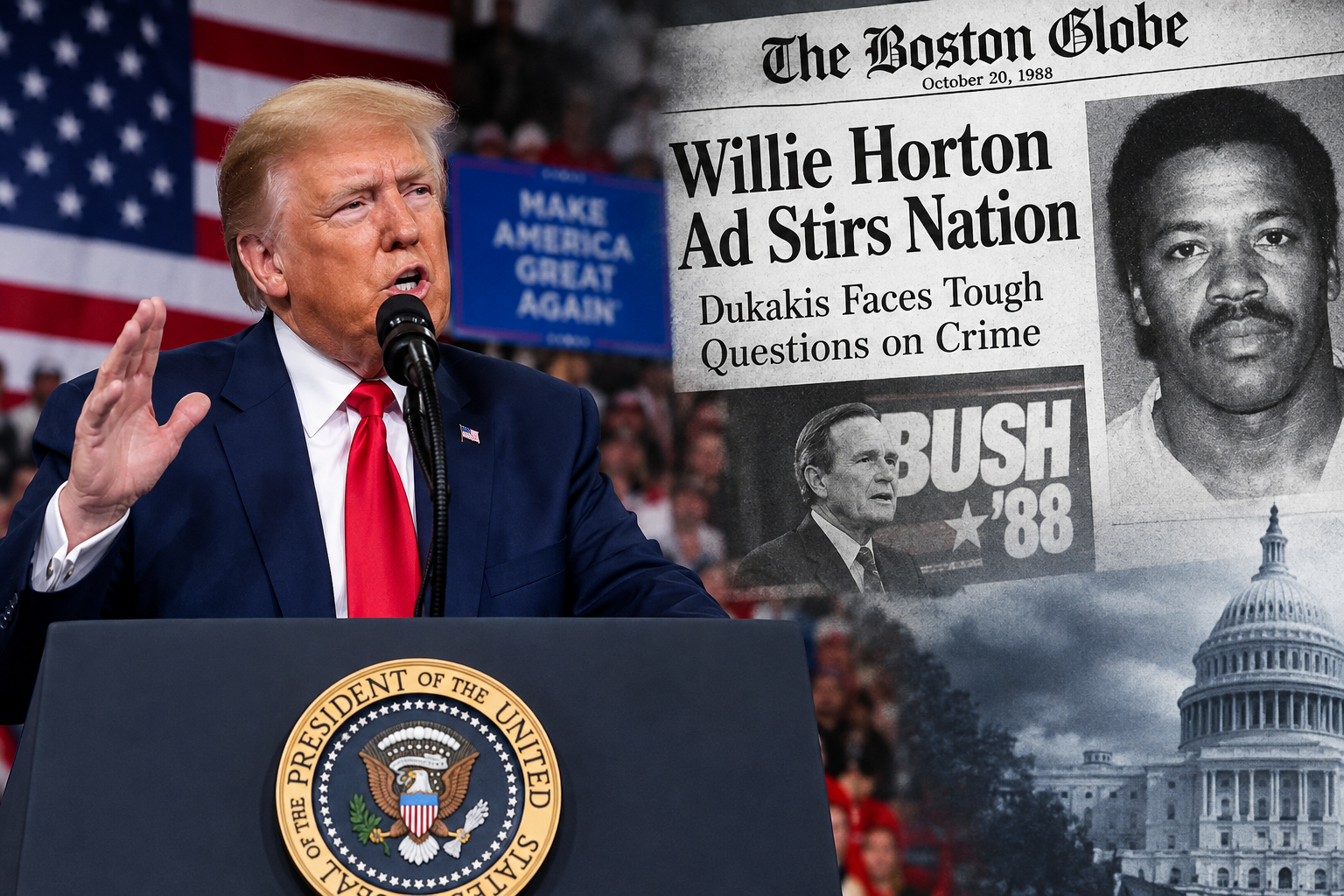
Trump Revives Willie Horton Reference at North Carolina Rally as Crime Takes Center Stage
President Donald Trump returned to one of the most controversial episodes in modern U.S. political history during a campaign rally in North Carolina, invoking Willie Horton and the 1988 presidential campaign while arguing that Democrats have been too lenient on crime.
Speaking Sept. 16 at a rally in Gastonia, Trump was campaigning for Republican U.S. Senate candidate Michael Whatley, who is challenging former North Carolina Gov. Roy Cooper. Trump used the Horton case to draw a comparison with the 2025 killing of Charlotte commuter Iryna Zarutska and to criticize Cooper and Democrats over criminal-justice policies.
Trump called Horton a “bad guy” and said the Charlotte case was the “same exact thing,” making the 1980s case part of his broader argument that voters should prioritize public safety and criminal accountability.
The comparison has also revived debate about the original Horton advertisement, its political impact and the racial controversy that has surrounded it for decades.
What Was the Willie Horton Case?
Willie Horton was serving a life sentence without parole in Massachusetts after being convicted of first-degree murder and armed robbery in connection with the 1974 killing of 17-year-old gas station attendant Joseph Fournier in Lawrence, Massachusetts. The Massachusetts Supreme Judicial Court later upheld Horton’s convictions.
In June 1986, Horton was released on a weekend furlough from a Massachusetts prison but failed to return.
In April 1987, while in Maryland, Horton entered the home of a couple in Oxon Hill. He attacked and stabbed the male resident and raped the woman before fleeing in a stolen vehicle. He was later captured and convicted in Maryland.
The case became a major political issue during the 1988 presidential campaign between Republican George H.W. Bush and Democratic Massachusetts Gov. Michael Dukakis.
How Horton Became a 1988 Campaign Issue
A political action committee supporting Bush produced the “Willie Horton” advertisement, which featured Horton’s mug shot and described the crimes committed after his furlough.
The ad was used to portray Dukakis as weak on crime. The issue became one of the most recognizable examples of how criminal justice could be used in presidential campaign advertising.
Historians and political commentators have subsequently debated the advertisement’s racial implications. History notes that the campaign strategy was widely viewed as exploiting racial fears surrounding crime, while contemporary reporting also documented the genuine policy dispute over Massachusetts’ furlough system.
The history is more complicated than simply attributing the furlough program to Dukakis. The Massachusetts program had been created before Dukakis became governor, and courts had extended eligibility to certain first-degree murderers. Dukakis nevertheless defended the program before Massachusetts changed the law in 1988 to exclude first-degree murderers from furloughs.
That distinction became an important part of the historical debate.
Why Trump Brought Horton Up in North Carolina
Trump’s 2026 reference came during a rally focused heavily on crime.
He was campaigning for Whatley against Cooper, who served as North Carolina governor from 2017 through 2024. Trump argued that Democratic policies had contributed to public-safety problems and pointed to the Charlotte killing as an example.
Trump specifically connected the Horton case with the case of Decarlos Brown Jr., who faces murder and other charges in connection with the August 2025 stabbing death of Zarutska on a Charlotte commuter train.
However, there is an important factual distinction: Cooper was no longer governor when Brown was released on pretrial supervision or when Zarutska was killed. Court records indicate Brown had been released on a misdemeanor case through a magistrate after Cooper left office. North Carolina corrections officials also said Brown was not among prisoners released early through a COVID-era settlement involving Cooper’s administration.
That does not prevent Trump from making a broader political argument about criminal-justice policy, but it means the specific comparison between Horton and Brown should not be presented as evidence that Cooper personally authorized Brown’s release.
Crime Becomes a Central Issue in the North Carolina Race
The Gastonia rally placed violent crime near the center of the North Carolina Senate campaign.
Trump displayed a large collection of mug shots while criticizing Cooper and Democratic criminal-justice policies. Republicans have also used crime and prisoner-release policies prominently in campaign advertising.
Cooper’s campaign has defended his record on crime and rejected Trump’s characterization of his policies.
The broader political debate comes against a changing national crime picture. The Washington Post reported that violent crime had declined during the Biden administration and continued falling during Trump’s second term, making today’s crime statistics different from the environment surrounding the 1988 Horton campaign.
That historical difference is significant: the Horton controversy emerged during a period when violent crime was approaching historically high levels, whereas today’s national crime environment is considerably different.
The Enduring Political Debate Over Crime and Release Policies
The Horton case continues to be cited whenever politicians debate how the criminal justice system should balance rehabilitation, incarceration, public safety and the risk posed by repeat offenders.
Trump’s decision to invoke Horton nearly four decades after the original campaign illustrates how durable that political symbolism has become.
For Trump’s supporters, the reference reinforces an argument for tougher criminal-justice policies and greater emphasis on keeping dangerous offenders incarcerated.
Critics argue that invoking Horton reproduces the racialized political messaging associated with the original 1988 campaign. Political historian Andra Gillespie told the Associated Press that the original advertisement’s use of Horton’s image contributed to racial associations surrounding the crime debate.
Both aspects are part of the historical record surrounding the Horton case.
What Trump’s Horton Reference Means for the 2026 Campaign
Trump’s use of the Horton example shows that the 1988 crime debate remains politically relevant almost four decades later.
But the circumstances are not identical.
Horton was a convicted murderer serving a life sentence who escaped during a prison furlough and later committed violent crimes in Maryland. The North Carolina case Trump referenced involves a defendant who was on pretrial release in a separate case and who now faces murder charges.
The cases can therefore be compared as part of a political argument about release policies, but they involve different legal circumstances.
As the North Carolina Senate campaign continues, crime is likely to remain a major issue for both candidates and their supporters. Trump’s decision to bring back the Willie Horton example gives the issue an unmistakable connection to one of the most consequential criminal-justice debates in modern campaign history.
One thought on “Trump Revives Willie Horton Reference at North Carolina Rally as Crime Takes Center Stage”
Leave a Reply

20% of the population commits 70 to 80%of violent crimes. Not to mention the large scale theft, Medicaid fraud, payroll protection fraud etc. When that segment of the population demonstrates a level of depravity & stupidity which renders them incapable of living in a civil society, then that society is doomed. The defenseless then have a choice: arm themselves or become statistics of failed law enforcement & empty rhetoric. End of story..