
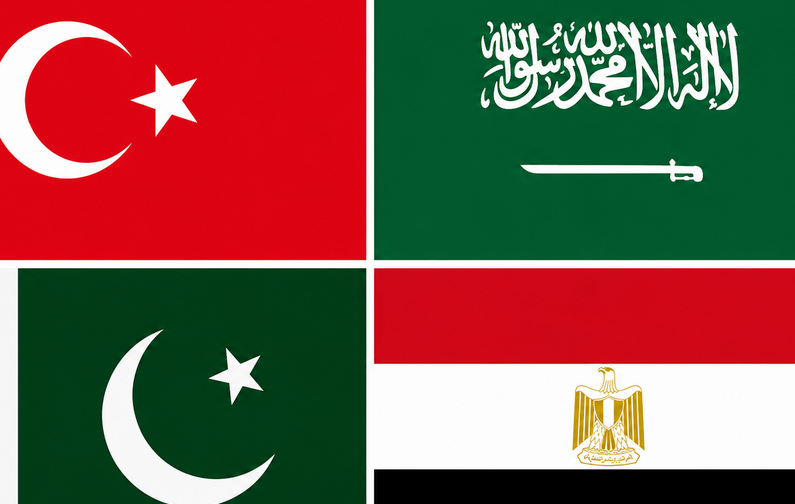
Historic Trilateral Defense Pact Signed in Mecca Saudi Arabia, Turkey and Pakistan Strengthen Regional Security
Saudi Arabia, Turkey and Pakistan announce a new mutual-defense framework aimed at strengthening regional cooperation, protecting trade routes and increasing the role of local powers in Middle Eastern security.
Saudi Arabia, Turkey and Pakistan have announced a major new defense partnership, bringing together three influential regional powers in an agreement designed to strengthen security cooperation and reduce vulnerabilities across the Middle East and South Asia.
The agreement, signed in Mecca by Saudi Crown Prince Mohammed bin Salman, Turkish President Recep Tayyip Erdoğan and Pakistani Prime Minister Shehbaz Sharif, establishes a framework for closer military and strategic coordination. At its center is a mutual-defense commitment under which an attack against one member would be treated as an attack against all three.
The announcement comes at a time when governments across the region are facing growing security concerns, from attacks on shipping and energy infrastructure to tensions involving Iran, Israel and militant groups operating across several countries.
For supporters of a stronger, more self-reliant regional security structure, the agreement represents an important shift: regional governments are taking greater responsibility for protecting their own interests while continuing to maintain relationships with major global powers, including the United States.
Three Countries, Three Strategic Strengths
The partnership brings together countries with very different but complementary capabilities.
Saudi Arabia provides enormous economic resources, energy influence and a central position in Gulf security. Riyadh has spent years investing in defense modernization and developing a broader regional diplomatic role.
Turkey brings a large military, a sophisticated domestic defense industry and extensive experience developing unmanned aircraft, armored vehicles and other military technologies. Ankara’s geographic position also gives it influence across Europe, the Middle East and the Black Sea region.
Pakistan contributes one of the region’s largest military forces, substantial defense-production experience and a long history of security cooperation with Gulf states.
Together, the three countries could create new opportunities for intelligence sharing, military exercises, defense production and maritime-security coordination.
The agreement’s significance, however, will depend on how quickly those ambitions translate into practical cooperation.
Protecting Critical Trade Routes
One of the most important challenges facing the region is the security of international shipping.
The Middle East contains several maritime chokepoints that are essential to global commerce, including the Red Sea, Bab el-Mandeb and the Strait of Hormuz. Disruptions in any of these waterways can affect energy markets, shipping costs and supply chains far beyond the region.
Saudi Arabia has a direct interest in protecting Red Sea commerce, while Pakistan’s location gives it an important connection to the Arabian Sea. Turkey, meanwhile, possesses extensive naval capabilities and strategic access connecting several major regions.
Greater cooperation among the three governments could therefore strengthen surveillance, information sharing and coordination around maritime threats.
Officials have emphasized the defensive character of the partnership, presenting it as a mechanism for deterrence rather than a platform for offensive military action.
A Different Approach to Regional Security
The agreement also carries a broader geopolitical message.
For years, Middle Eastern security has depended heavily on outside military powers, particularly the United States. Washington remains an important security partner for several governments in the region, but countries such as Saudi Arabia and Turkey have increasingly sought greater strategic independence.
That trend fits with an argument frequently associated with President Donald Trump: U.S. allies should take greater responsibility for their own defense while maintaining strong partnerships with Washington.
Trump’s supporters are likely to view the new arrangement as evidence that regional governments are becoming more willing to shoulder the burden of their own security.
Rather than requiring the United States to carry every regional security responsibility, stronger local alliances could allow Washington to focus American military resources on threats directly affecting U.S. interests.
That does not mean American influence is disappearing. The United States remains deeply connected to Gulf security, global energy markets and defense cooperation with Saudi Arabia and other regional partners.
Instead, the emerging model could involve regional countries assuming a larger share of the responsibility while maintaining strategic relationships with Washington.
Economic Cooperation Could Be Just as Important
Defense agreements increasingly overlap with economic policy.
Saudi Arabia’s enormous investment capacity, Turkey’s manufacturing base and Pakistan’s workforce and defense industry could create opportunities for cooperation extending beyond traditional military arrangements.
Joint defense production, technology development and infrastructure projects could become important parts of the partnership if the three governments move beyond the initial agreement.
Such cooperation could also strengthen domestic industries and reduce reliance on imported equipment over time.
However, the pact’s long-term economic impact remains uncertain. Large defense agreements often require years of negotiations, financing and technical coordination before producing measurable results.
What Happens Next?
The immediate challenge will be turning the agreement into an effective security structure.
That could involve regular military exercises, intelligence-sharing mechanisms, coordinated maritime patrols and agreements governing how the three countries would respond to a serious attack.
The most important question will be whether the mutual-defense commitment becomes a functioning operational arrangement or remains primarily a political declaration.
The partnership also raises questions about how it will interact with existing alliances and regional organizations. Saudi Arabia, Turkey and Pakistan each maintain relationships with different international powers, and balancing those relationships will require careful diplomacy.
For President Trump’s supporters, the development offers a potentially attractive vision of regional allies taking greater responsibility for their own security while the United States maintains influence without assuming every military burden itself.
For the three signatories, meanwhile, the priority is more immediate: protecting their countries, strengthening deterrence and securing the trade routes that underpin their economies.
The Mecca agreement therefore represents more than a diplomatic ceremony. Its real significance will be measured by what happens next—whether three major regional powers can convert political cooperation into a durable security partnership capable of protecting their interests in an increasingly uncertain Middle East.