Inside Camp David Trump’s Cabinet Says America Has Entered a “Golden Age”
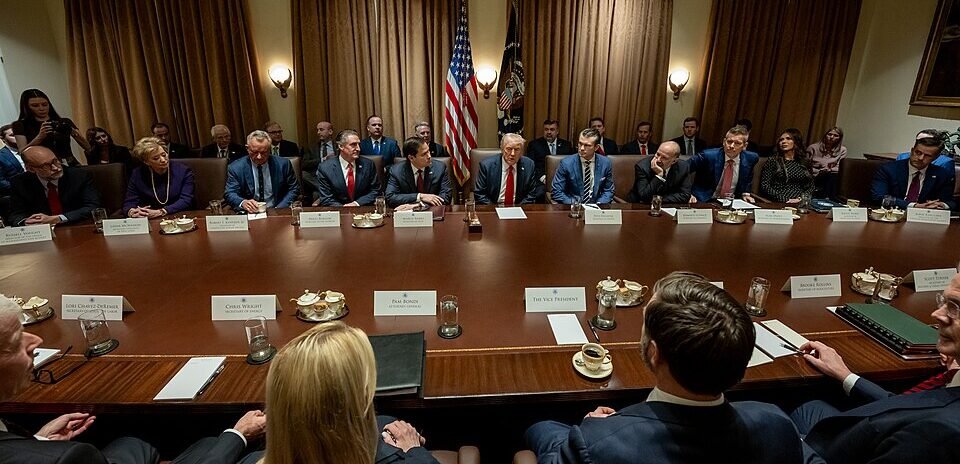
What followed was less a photo-op and more a department-by-department accounting. Trump opened by framing the last year and a half against what he described as the mess his administration inherited — the worst inflation in decades, a border he called out of control, and trade deficits he said had spiraled out of proportion. From there, he pointed to a manufacturing rebound he credits to tariff policy, arguing that automakers from Germany, Japan, South Korea, and Canada are now breaking ground on U.S. soil rather than shipping cars in.
He tied that industrial push to a run of good news on Wall Street — dozens of record highs on the major indexes this year — and to retirement accounts, claiming the average 401(k) has grown by tens of thousands of dollars since he took office. He also pointed to price cuts at major grocery chains, including Walmart, Sam’s Club, and Giant Eagle, as evidence that inflation is finally cooling.
One of the pieces Trump leaned into hardest was the Trump Accounts program — tax-advantaged savings accounts the administration has begun seeding for millions of American children, meant to give them a head start on long-term investing. Between the federal seed money and private contributions from companies that have signed on, the administration is betting the accounts become a signature legacy piece.
On healthcare, Trump described a “Most Favored Nation” pricing push that ties U.S. drug prices to what other wealthy countries pay, arguing for years Americans were effectively subsidizing cheaper medicine abroad. He said the strategy — paired with the threat of tariffs on countries that don’t play along — has already forced steep discounts on a range of drugs, and he wants it to go further.
PT: “The level of corruption and fraud that took place under the Biden administration was unprecedented.” — President Trump
Then came Vice President JD Vance, who runs the administration’s fraud task force and used his time at the table to lay out numbers he called some of the most significant of the term. Vance said the task force has identified $230 billion in fraudulent government spending since it launched, and has already managed to halt $56 billion of it before the money went out the door. He also previewed 17 new enforcement actions worth roughly a third of a billion dollars, layered on top of that total. Vance was careful to note that recovering money already disbursed is far harder than stopping it in the first place — which is part of why the task force’s early-detection work, including new Treasury screening that flags payments headed to deceased recipients, has become a priority.
Secretary of State Marco Rubio closed out the domestic-to-global pivot with an update on foreign policy. He argued the International Criminal Court has overstepped its legitimacy by pursuing action against non-member nations, including the U.S. — a position he said has already prompted several countries to walk away from the court. Rubio also touched on a summit the administration hosted aimed at coordinating with allies against far-left extremist networks, along with what he described as renewed direct dialogue between Israel and Lebanon after decades of near-total silence between the two governments.
Trump, for his part, spent time on other fronts too — pointing to ongoing negotiations involving Iran’s nuclear program, updates on the war in Ukraine, and a defense of his administration’s approach to a disputed anti-weaponization fund that’s become a sticking point in the Senate.
Taken together, the meeting was as much a message as it was a briefing: an administration eager to show its work in public, on camera, in a room few Americans have ever seen — and confident enough in the numbers to let reporters ask questions about them directly. Whether the country buys the “Golden Age” framing is a separate question from the one Friday’s meeting was built to answer. But as a display of an administration wanting to be seen doing the math out loud, it was hard to miss.