The Gulf Is Burning Again — and Nobody Has a Plan to Stop It
West Asia Crisis
Drones over Kuwait. A cargo ship on fire in Qatari waters. An oil spill Iran won’t acknowledge. The ceasefire that was supposed to hold the region together is looking thinner by the day.
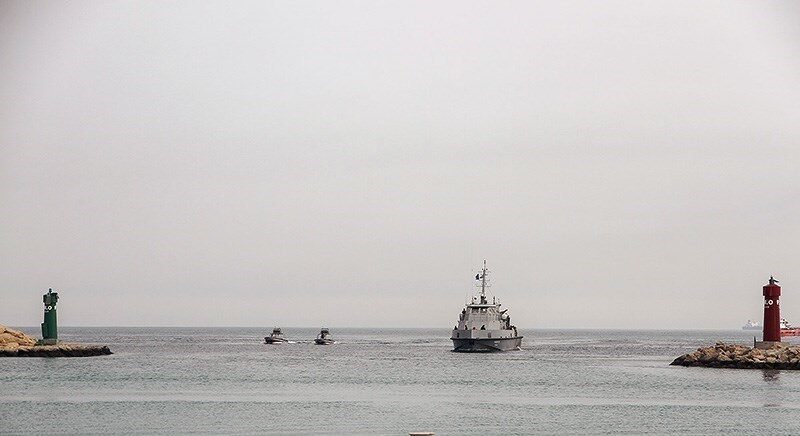
A ceasefire, in theory, means the shooting stops. In the Strait of Hormuz right now, it mostly means the shooting has become slightly more deniable.
Over the past week, the UAE reported its air defenses intercepting Iranian drones. Kuwait said drones entered its airspace and were “dealt with” — careful language that stops short of pointing fingers, though few in the region need them pointed. A cargo vessel caught fire in Qatari waters after a drone strike. And satellite images circulating among shipping analysts appear to show a significant oil slick spreading from Iran’s Kharg Island, the terminal through which much of the country’s crude exports flow. Iran says there’s no spill. The satellite images suggest otherwise.
“We haven’t seen this level of activity in the Strait since before the ceasefire was declared — and even that ceasefire was always more of a pause than a peace.”
None of this is entirely new. Iran has spent years calibrating exactly how much pressure it can apply in the Gulf before triggering a response it isn’t ready for. What’s changed is the tempo. Analysts tracking the region say this past week has seen more kinetic activity than any single week since the ceasefire was announced roughly a month ago.
Diplomacy in one hand, drones in the other
Iran did, notably, send a formal response to the US proposal aimed at ending the broader West Asia conflict. According to Iranian state media, Tehran’s position is that any talks will focus exclusively on ending the war — not on its nuclear program, not on its ballistic missile development, and certainly not on its posture toward Israel.
President Masud Pezeshkian was direct: negotiations don’t mean surrender or retreat. That framing matters. Iran isn’t walking away from the table — but it’s also making clear it intends to show up to that table having just launched drones at three neighboring countries.
“If this is what Iran does without nuclear weapons, what is it going to do with them?” — Secretary of State Marco Rubio
It’s a fair question, even coming from Rubio, who is not exactly a disinterested party. Iran has previously stated it possesses enough enriched uranium for eleven nuclear devices. It hasn’t built them — at least not that anyone can confirm — but it has made very sure everyone knows the raw material is there. That’s leverage, and Tehran knows how to use leverage.
STATE OF PLAY — MAY 2026
- UAE air defenses intercept Iranian drones; Kuwait reports airspace violations
- Cargo vessel struck and set ablaze in Qatari waters
- Satellite imagery suggests oil spill at Iran’s Kharg Island terminal — Tehran denies it
- Iran sends diplomatic response to US; limits scope to ending the war, excludes nuclear talks
- Ceasefire technically holds but analysts describe it as the most strained period since it began
Why the Gulf states keep ending up in the crosshairs
The UAE and Bahrain are obvious targets for a straightforward reason: they normalized relations with Israel under the Abraham Accords. In Iran’s strategic worldview, that makes them collaborators. But the targeting logic in this conflict has never been entirely coherent — Iran struck Qatar and Turkey in earlier rounds despite both nations being broadly sympathetic to Hamas leadership. That either reflects a breakdown in targeting discipline or a deliberate message that nobody in the region is safe. Neither interpretation is reassuring.
What makes the current moment particularly hard to read is that Iran appears to be doing two things simultaneously: signaling openness to diplomacy while continuing to escalate militarily. That’s not necessarily a contradiction — it may be a negotiating tactic, a way of demonstrating that the cost of not reaching a deal keeps rising. But it’s a risky game to play when the other side includes a US administration that has shown it’s willing to act unpredictably.
The pattern is familiar: world leaders declare Iran will not be allowed to get nuclear weapons, then hand the problem to the next government. Trump seems determined to break that cycle — though whether he can, and at what cost, remains entirely unclear.
Defense analyst James Marlo, speaking from London, put it bluntly: Iran is patient. It has watched multiple US administrations come and go, each inheriting the same unresolved problem, each kicking it forward. The calculation in Tehran may well be that even if this administration holds firm, the next one might not.
For the moment, flights in and out of the region are being monitored hour by hour. Insurance premiums on Gulf shipping lanes have climbed sharply. The ceasefire, such as it is, remains technically in place. But nobody who has been watching this region for more than a week believes the current situation is stable. The question isn’t whether it will flare again — it’s whether, when it does, anyone on either side will have thought through what comes next.