Rubio Said a Nuclear Iran Would Hold the World Hostage. Iran Already Is.
Analysis · U.S. Foreign Policy
The Secretary of State made his most powerful case yet for why Iran can’t have a bomb — but the argument came with a contradiction baked right into it.
THE NUMBERS BEHIND RUBIO’S ARGUMENT
25% of global oil trade transits the Strait of Hormuz
$4.50 average U.S. gas price right now — up sharply since closure
90% of Iranian trade halted under current U.S. sanctions
$500M Iran’s estimated daily revenue loss from the blockade
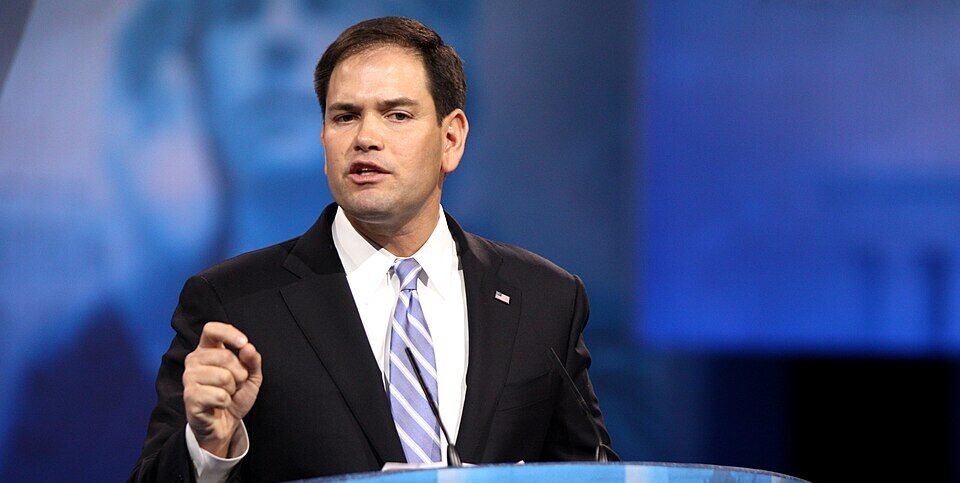
Marco Rubio came to the White House briefing room on Wednesday with a clear mission: explain why the United States is escorting commercial ships through the Strait of Hormuz, and why a nuclear Iran would make all of it so much worse. He’s a skilled communicator, and the case he made was mostly compelling. But buried inside his argument was a tension that reporters didn’t push on — and probably should have.
Here’s what he said, in plain terms: if Iran ever gets a nuclear weapon, they could close the Strait of Hormuz, send gas prices to $9 a gallon, and there would be nothing anyone could do to stop them. The bomb would give them immunity. That’s why this whole operation — the military escort convoys, the sanctions, the UN resolution — has to succeed.
It’s a real argument. The problem is the premise.
“If Iran had a nuclear weapon and they decided to close the straits… we wouldn’t be able to do anything about it.”— SECRETARY OF STATE MARCO RUBIO, WHITE HOUSE BRIEFING
Iran already closed the strait. Without a nuclear weapon. And the world — including the United States — is clearly struggling to fully reopen it. If the deterrent effect of a bomb is the ability to act with impunity in the strait, then Iran has already demonstrated that capability with conventional forces, mines, and small fast boats. The nuclear scenario Rubio described isn’t hypothetical. A version of it is already happening.
THE ARGUMENT VS. THE REALITY
RUBIO’S WARNING
A nuclear Iran could close the Strait and hold global oil markets hostage with no recourse for the West.
CURRENT REALITY
Iran has already closed the Strait using mines and fast boats — without a bomb — causing real pain to global energy markets.
WHAT CHANGES WITH A BOMB
Military response becomes far more dangerous. Any escalation risks nuclear exchange. The margin for error collapses to near zero.
WHAT DOESN’T CHANGE
The economic leverage Iran holds over global shipping exists independently of their nuclear status — as this crisis proves.
To be fair to Rubio — and the argument does deserve some fairness — the difference between a nuclear Iran and a conventional one isn’t just about the strait. A nuclear-armed Iran means that any military response to a strait closure, like the one currently underway, becomes exponentially more dangerous. Right now, the U.S. can escort ships, shoot down Iranian fast boats, and impose a counter-blockade. With a nuclear Iran in the picture, that calculus changes in ways that are genuinely frightening. That’s real.
But the framing he chose — that a nuclear weapon is what would give Iran the power to threaten the world’s oil supply — gets the order of events backwards. They threatened it first. The bomb would just make the response harder. That’s a different argument, and actually a stronger one, but it’s not the one Rubio made.
ANALYSIS
The administration’s most persuasive case against a nuclear Iran isn’t about the Strait of Hormuz — it’s about what happens in every future crisis when there’s a bomb in the background. The current mess would be vastly more dangerous if the conversation about de-escalation came with a nuclear overhang. That’s the argument that actually holds. The “they’d close the strait” framing is easier to say but harder to defend when the strait is already closed.
Rubio also addressed the question of gas prices directly for the first time in some time — and acknowledged $4.50 a gallon without flinching. His argument was essentially: the United States is better insulated than most countries because it’s now a net oil exporter, global prices would be much higher without U.S. intervention, and the cost of letting Iran get a nuclear weapon is far higher than a temporary pump price spike. Those points aren’t wrong. But “be grateful it’s not worse” has never been a great political message, and Rubio, who’s usually sharp about these things, knows it.
The broader picture he painted of Iran’s situation — an economy in freefall, inflation at 70%, a currency in collapse, a navy at the bottom of the sea, and a leadership structure so fractured that diplomatic offers take days to get a response because someone has to “find the supreme leader wherever he hides” — suggests a regime under far more pressure than it admits publicly. Rubio’s read is that they can absorb pain but not unlimited pain. He’s probably right about that. The question is how much pain the rest of the world absorbs in the meantime.
“They should check themselves before they wreck themselves in the direction that they’re going.”— SECRETARY RUBIO, ON IRAN’S ESCALATION OPTIONS
On the diplomatic front, Rubio was careful — perhaps more careful than usual. He confirmed that envoys Steve Witkoff and Jared Kushner are working on a framework for talks, and that any deal would have to address not just enrichment limits but what happens to the highly enriched uranium that’s already stockpiled and buried. He declined to say how close those talks are, citing concern about poisoning the negotiations. Reading between the lines, there’s something there — but it’s fragile.
What Rubio did not do is offer a timeline. No date by which the strait would be fully open. No milestone at which gas prices would come down. No benchmark for when “Project Freedom” — the convoy escort operation — would be declared a success. That’s either deliberate strategic ambiguity or an admission that nobody knows. Possibly both.
The argument for stopping Iran’s nuclear program is real and serious. But it’s worth being precise about what a bomb actually adds to the threat — because framing it as the source of the threat, when the threat is already demonstrably in play, invites the question the White House probably doesn’t want asked: if Iran can do all this without a bomb, what exactly were we waiting for?