France Protests Turn Violent as Arrests Mount Nationwide
Violent Unrest Rocks France Following Nationwide Protests
More than half a million people reportedly joined demonstrations as clashes, property damage and political tensions intensified across the country.
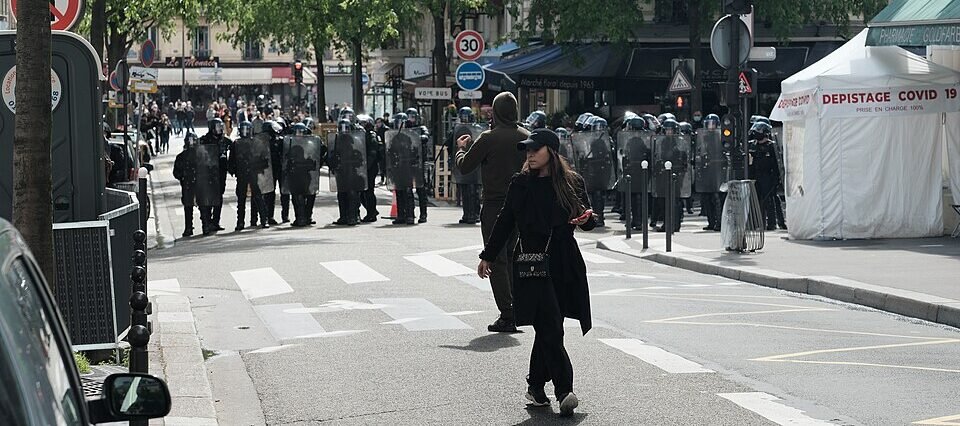
France has been shaken by widespread demonstrations that escalated into violent clashes, arson and looting, with authorities reporting approximately 1,200 arrests during a turbulent weekend. The protests, which reportedly drew more than half a million people nationwide, reflected growing frustration over living costs, public services and proposed government budget cuts.
According to the video report, demonstrations took place across the country, including in Paris, Marseille and several other major cities. While many participants initially gathered peacefully, some gatherings deteriorated as groups clashed with police and public buildings and businesses became targets of vandalism.
The unrest has placed renewed pressure on Prime Minister Sébastien Lecornu’s government, which faces the challenge of responding to public grievances while maintaining public order amid an increasingly divided political environment.
Nationwide Demonstrations Escalate
The protests were driven by a range of concerns, including the cost of living, education, healthcare and proposed reductions in public spending. Demonstrators expressed frustration over the direction of government policy and questioned whether public institutions were adequately addressing the pressures facing ordinary households.
The scale of the demonstrations made them a significant test for French authorities. The video report estimated that more than 500,000 people took to the streets, although the precise number of participants may vary according to the source and method of counting.
Many demonstrations began as organized marches. However, the situation changed in several locations as smaller groups reportedly broke away from established routes and engaged in confrontations or property damage.
The report described disturbances in at least 10 major cities. Police deployed tear gas and water cannons in efforts to disperse crowds and restore order.
The events illustrated the difficulty of managing large demonstrations when peaceful protest activity overlaps with smaller groups engaged in violence. Authorities must protect public safety while also preserving the right of citizens to demonstrate and criticize government policy.
Public Buildings and Historic Sites Damaged
Damage to public infrastructure became one of the most striking features of the unrest.
According to the video report, a fire broke out at the historic town hall in Limoges, central France. The building, described as approximately 140 years old, reportedly suffered significant damage when its distinctive spire collapsed.
Other incidents of vandalism and looting were reported at municipal buildings, tourist offices and employment centers. These locations serve everyday public needs, meaning damage can affect residents well beyond the immediate area of a confrontation.
The report also said that crowds moved close to the Élysée Palace, the official residence of the French president in Paris. The proximity of demonstrators to a major seat of government added to concerns about security around national institutions.
Police faced the task of containing disturbances across multiple locations while protecting residents, businesses and public property.
The damage has also raised questions about the distinction between legitimate political dissent and criminal conduct. Demonstrating against a government policy is a protected democratic activity, but arson, assault and deliberate destruction of property are separate matters that authorities may investigate and prosecute.
Government Condemns Violence
Prime Minister Sébastien Lecornu publicly condemned the violence, according to the report. He attributed the disturbances to what he described as an organized extreme-left network and argued that public institutions had been deliberately targeted.
Those allegations represent the government’s assessment of the events. The video report does not establish that every incident was coordinated by a single organization, and responsibility for individual acts must be determined through evidence and investigation.
President Emmanuel Macron also raised concerns about the possibility of foreign actors attempting to encourage social unrest. The report said security services had monitored online activity and detained individuals suspected of encouraging riots or organizing disruptions before the demonstrations.
However, the existence of such concerns does not by itself establish foreign involvement. Investigators would need evidence to determine whether outside actors played a role and, if so, to what extent.
The government’s immediate priorities include identifying those responsible for violence, assessing damage and preventing further disturbances.
Economic Pressure and Political Uncertainty
The demonstrations have unfolded against a difficult economic and political backdrop.
The cost of living remains a central concern for many households, while proposed budget reductions affecting public services have intensified debate about the government’s priorities. Education, healthcare and social welfare are particularly sensitive areas because changes to funding can affect families, workers and local communities directly.
France’s political landscape has also complicated the government’s position. The video report described a parliament without a single party holding an absolute majority, making it harder for the administration to secure support for its legislative agenda.
That fragmentation can make budget negotiations and broader policy decisions more difficult. It can also create opportunities for opposition parties to challenge the government’s direction.
With presidential elections approaching in April, political movements on both the left and right are preparing to make their cases to voters. The unrest could therefore become part of a wider debate over public spending, economic management, law enforcement and the government’s response to social discontent.
Still, the demonstrations should not be treated as evidence that all protesters share the same political objectives. Large nationwide movements often bring together people with different demands, priorities and views.
Security Concerns and the Road Ahead
Authorities now face the dual challenge of restoring calm and addressing the grievances that helped bring people onto the streets.
A heavy security response may be necessary when violence threatens residents or public infrastructure. At the same time, the government must distinguish peaceful demonstrators from those responsible for criminal acts and ensure that enforcement measures remain proportionate.
The video report also indicated that labor unions and activist groups were considering further strike action in early November. If those plans proceed, France could face additional disruption to transport, public services and economic activity.
The scale of the reported arrests and the damage to historic and public buildings have made the weekend a significant moment for the country. But the longer-term consequences will depend on what happens next: whether authorities can prevent further violence, whether political leaders can negotiate over disputed policies, and whether public concerns receive a meaningful response.
For now, France remains caught between demands for political and economic change and the urgent need to maintain public safety.
The demonstrations have exposed deep frustrations, but the path forward will require more than arrests and emergency measures. It will depend on accountability for violence, protection of democratic rights and a credible response to the economic pressures facing French citizens.
Source: User-provided video transcript and accompanying summary. Figures and allegations are attributed to the report and have not been independently verified for this article.