Trump Welcomes Xi as U.S.-China Trade Truce Takes Center Stage
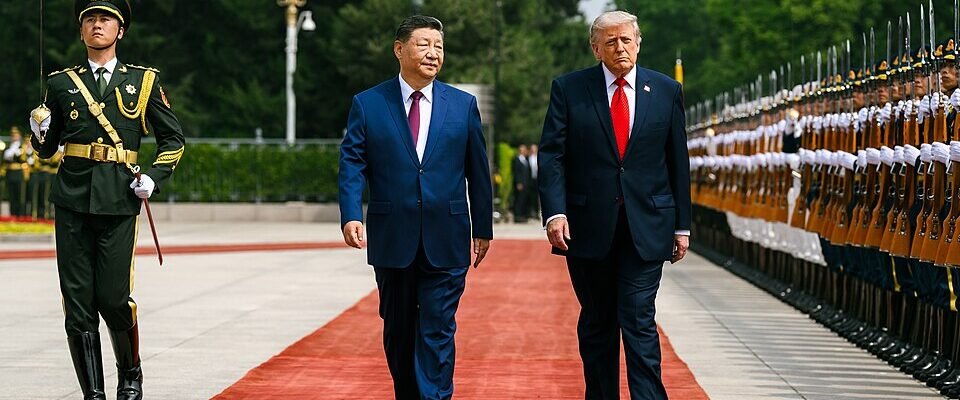
President Donald Trump’s meeting with Chinese President Xi Jinping has placed trade, technology and economic security back at the center of the U.S.-China relationship.
Trump personally welcomed Xi at Joint Base Andrews in Maryland, marking the beginning of a high-profile visit focused on issues that have increasingly shaped relations between the world’s two largest economies.
The encounter comes as Washington and Beijing work to maintain a fragile trade truce. According to the material surrounding the meeting, Treasury Secretary Scott Bessent said the two sides had extended the existing tariff arrangement through January, providing businesses with additional time to plan while negotiations continue
The extension does not resolve the deeper disagreements between the countries. Instead, it creates another window for negotiations over tariffs, trade balances, technology and supply-chain security.
Tariffs Remain a Central Bargaining Tool
Trade policy has been one of the defining elements of Trump’s economic agenda.
The administration has argued that tariffs can give Washington greater leverage when negotiating with countries whose trade policies it considers unfavorable to American businesses.
China has remained at the center of that strategy.
The United States and China have spent years disputing tariffs, market access, intellectual property, technology transfers and industrial policy. American officials have also raised concerns about dependence on Chinese manufacturing for strategically important products and materials.
For the Trump administration, maintaining tariff leverage is therefore about more than the immediate cost of imported goods. It is part of a broader effort to strengthen America’s negotiating position.
Critics of tariffs, however, argue that import duties can also increase costs for American companies and consumers, particularly when businesses rely on foreign components or materials.
The current truce reflects that tension: both governments have an interest in avoiding a sudden escalation while continuing to negotiate over unresolved issues.
AI Adds a New Dimension
Technology is another major issue confronting Trump and Xi.
Artificial intelligence has rapidly become a national-security and economic priority for both Washington and Beijing. The competition extends beyond commercial applications into advanced computing, military technology, semiconductor production and data infrastructure.
The material surrounding the summit says Chinese and American officials have discussed AI safeguards, including communication mechanisms intended to reduce the risk of serious misunderstandings.
At the same time, Washington faces a difficult balancing act.
The United States wants to preserve its technological lead while avoiding policies that unnecessarily restrict American companies. It also wants to prevent advanced technologies from being transferred to potential strategic competitors in ways that could strengthen foreign military capabilities.
That makes AI policy part of the larger U.S.-China competition rather than a standalone technology issue.
Rare Earths and Supply-Chain Security
Another concern is America’s dependence on China for critical minerals and other industrial inputs.
Rare-earth elements are essential to numerous technologies, including electronics, electric motors and defense systems. China has a major position in the global processing and supply of these materials, making diversification an important issue for U.S. policymakers.
The Trump administration has emphasized domestic production and partnerships with allied countries as ways to reduce supply-chain vulnerabilities.
The broader objective is to make the American economy less exposed to disruptions originating outside the United States.
Supporters describe that approach as economic security. Critics can point to the cost and difficulty of rapidly rebuilding domestic supply chains that have developed internationally over decades.
Either way, the issue is becoming increasingly difficult for Washington to ignore.
More Than a Trade Meeting
The Trump-Xi encounter comes at a moment when economic and national-security questions are increasingly connected.
Trade negotiations now overlap with debates over semiconductors, artificial intelligence, critical minerals, energy security and military technology.
That means even a temporary tariff agreement can have consequences far beyond customs duties.
For American businesses, the extension of the trade truce offers additional predictability. For policymakers, it provides time to negotiate without immediately returning to a broader escalation in tariffs.
But the underlying disagreements remain.
Washington wants greater access for American companies, stronger protection for intellectual property and more resilient supply chains. Beijing has its own economic and strategic priorities and has repeatedly resisted measures it views as attempts to constrain China’s development.
The result is a relationship defined by cooperation in some areas and intense competition in others.
What Comes Next
The January deadline gives both governments another opportunity to determine whether the current pause can develop into a broader agreement.
The outcome will depend on negotiations over tariffs and purchasing commitments, as well as wider disputes involving technology and strategic industries.
For Trump, the meeting also represents an opportunity to demonstrate the negotiating approach that has defined his return to the White House: use America’s economic size and market power as leverage while keeping pressure on Beijing.
Whether that strategy produces a durable agreement remains to be seen.
What is clear is that the U.S.-China relationship has moved far beyond a traditional argument over tariffs. Trade, technology and national security are now closely intertwined.
As Trump and Xi continue their discussions, businesses and governments around the world will be watching for signs of whether the latest truce becomes a foundation for a longer-term settlement—or simply another pause in a much larger strategic competition.