
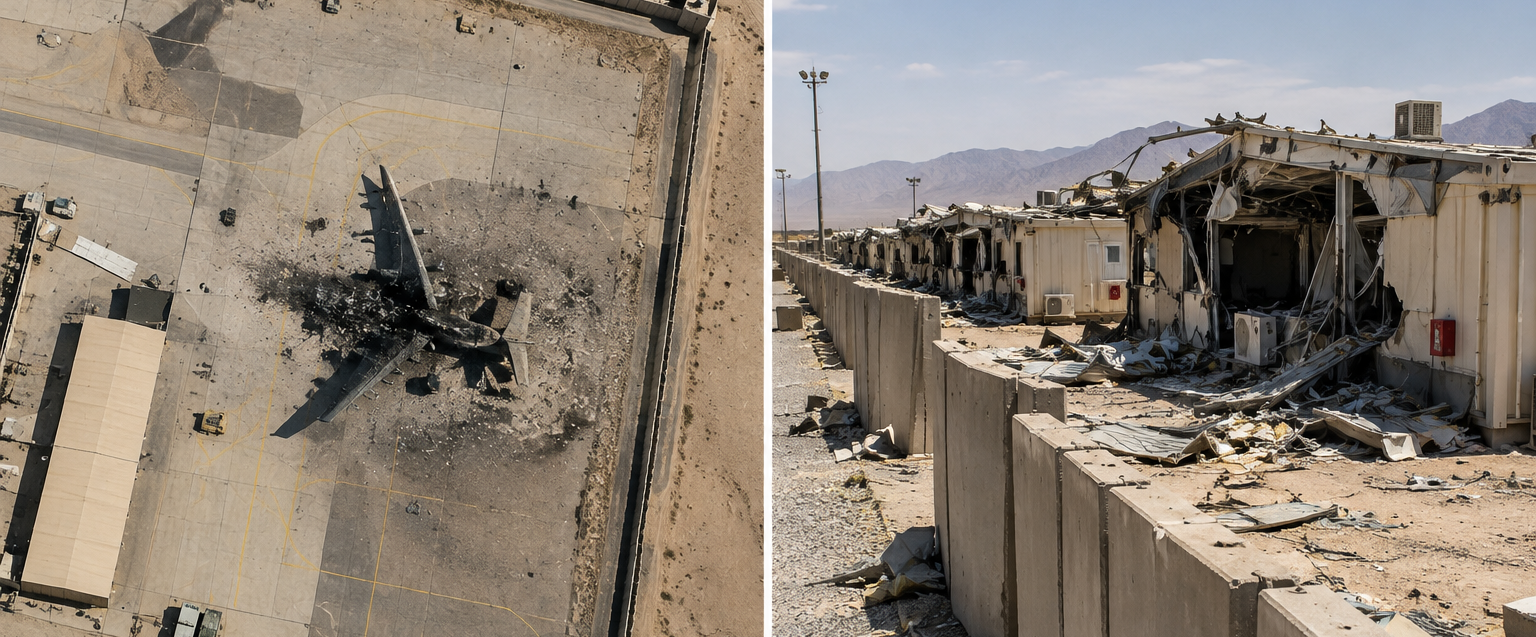
Photos Reveal Extensive Damage at U.S. Military Bases After Iranian Strikes
New photographs obtained from U.S. service members, together with a recent Pentagon Inspector General report, are providing a clearer picture of the physical damage sustained by American military facilities during the war with Iran.
The images, reported by CBS News and ABC News, show damaged buildings, vehicles and aircraft at U.S. positions in the Middle East. The Pentagon Inspector General separately reported that Iranian strikes damaged or destroyed hundreds of buildings and structures at U.S. bases across Kuwait, Bahrain, Qatar, the United Arab Emirates, Saudi Arabia, Iraq, Oman and Jordan.
The disclosures come as the Pentagon is also assessing the broader financial and military cost of Operation Epic Fury. A mandatory Inspector General report found that the operation had cost an estimated $33.4 billion through June 30, including $22.3 billion in expended munitions and $3.7 billion in equipment losses.
Photos Show Damage at U.S. Bases in Saudi Arabia and Kuwait
Some of the most striking images came from Prince Sultan Air Base in Saudi Arabia, where a U.S. E-3 Sentry aircraft was heavily damaged in an Iranian attack.
The E-3, commonly known as the AWACS, is an airborne early-warning and command-and-control aircraft. Earlier reporting from Air & Space Forces Magazine documented significant damage to an E-3 at Prince Sultan following an Iranian missile and drone attack in March.
New photographs obtained by CBS News show the aircraft with its rear fuselage and tail section severely damaged. Other images from the base show damaged buildings and barracks.
At Camp Buehring and Camp Arifjan in Kuwait, photographs show destroyed vehicles and damage to buildings and other facilities. Camp Buehring is a major staging area for U.S. Army troops and armored vehicles.
The images provide a visual complement to the Pentagon Inspector General’s broader assessment that Iranian attacks caused damage at American installations across eight Middle Eastern countries.
U.S. Aircraft Also Damaged in Jordan
American aircraft have also been damaged at Muwaffaq Salti Air Base in Jordan.
CBS News reported that an Iranian missile attack in September struck an A-10 Thunderbolt II, destroying one of its wings. Approximately eight F-15 aircraft also sustained lighter damage, although those aircraft were subsequently returned to service, according to people familiar with the incident.
Air & Space Forces Magazine independently reported that the A-10 suffered severe wing damage and that about eight F-15E Strike Eagles were damaged but remained serviceable. U.S. officials said no American personnel were killed in that particular attack.
The incidents illustrate that missile defenses can intercept many incoming weapons without preventing every strike from causing damage to aircraft, buildings or other equipment.
Pentagon Watchdog Puts Equipment Losses at $3.7 Billion
The physical damage to bases is only part of the broader cost of the conflict.
The Pentagon Inspector General’s report estimated $3.7 billion in equipment losses through June 30. The report also identified significant losses involving aircraft and unmanned systems, including four F-15s destroyed, one F-35 damaged, seven KC-135 tanker aircraft damaged or destroyed and as many as 30 MQ-9 Reaper drones lost.
The $3.7 billion figure is separate from the estimated $33.4 billion total cost of Operation Epic Fury during the period covered by the report.
The larger figure included:
- $22.3 billion in expended munitions
- $7.4 billion in cumulative incremental obligations
- $3.7 billion in equipment losses
The report noted that the $33.4 billion estimate does not include the cost of repairing infrastructure damaged during the conflict.
The Congressional Budget Office subsequently estimated the overall cost of the war at about $38 billion through August 1, with spending potentially increasing by roughly $2 billion to $3 billion per month.
More Than 50,000 U.S. Personnel Took Part
The Pentagon Inspector General’s assessment also provides a broader picture of the scale of the operation.
More than 50,000 U.S. service members participated in Operation Epic Fury during the period covered by the report, according to Stars and Stripes. The operation involved thousands of combat missions and extensive use of precision-guided weapons and missile interceptors.
The report also warned of “strategic inventory shortfalls” and bottlenecks in the U.S. defense-industrial base that could slow the replacement of expended munitions.
That finding has raised broader questions about how quickly the United States can replenish some high-demand weapons while continuing operations in the region.
What the Damage Says About Base Protection
The photographs also highlight a longstanding challenge for U.S. forces operating from fixed installations: protecting personnel and expensive equipment against increasingly sophisticated missile and drone attacks.
Concrete barriers, hardened structures and air-defense systems can reduce the consequences of attacks, but they cannot guarantee that every aircraft, vehicle or building will escape damage.
The Pentagon Inspector General’s finding that hundreds of structures were damaged or destroyed across multiple countries demonstrates the scale of the challenge.
The attacks have therefore put renewed attention on questions surrounding base hardening, aircraft dispersal, shelters, missile-defense coverage and the availability of interceptors.
The issue extends beyond the immediate cost of repairing damaged facilities. Military planners must also consider how fixed installations can remain operational when adversaries can combine ballistic missiles, drones and other weapons in repeated attacks.
A Broader Test for U.S. Military Readiness
The latest disclosures arrive as the United States faces pressure to maintain its military operations while rebuilding depleted weapons inventories.
The Pentagon Inspector General’s report specifically identified munitions resupply problems and industrial-base bottlenecks. Separately, reporting has documented heavy use of Patriot and THAAD interceptors during Iranian attacks.
For the Pentagon, the challenge is therefore twofold: repairing facilities and equipment already damaged while replacing the weapons used to defend those facilities.
The photographs from Saudi Arabia, Kuwait and Jordan offer a tangible view of the first problem. The Inspector General’s figures on equipment losses, munitions spending and supply constraints illustrate the second.
Together, they provide a more detailed picture of the material costs of the conflict than was available from official public statements earlier in the year.
Sources & Deep-Dive Verification
- Primary Broadcast & Investigative Reports:
- ABC News / Politics Desk: “Photos show extensive damage to US Middle East bases,” investigation featuring active-duty servicemember dispatches and casualty metrics.
- CBS News National Security Desk: “New photos show widespread damage at U.S. positions caused by Iranian missile, drone attacks,” reporting on the Camp Buehring and Prince Sultan strikes.
- Government Oversight & Military Audits:
- DoD Office of Inspector General: Mandated Report to Congress on Equipment Losses and Infrastructure Damage across U.S. Central Command Facilities.
- Congressional Budget Office (CBO): Operational Expenditure Estimates on Middle East Theater Logistics ($38B evaluation).
- Regional Coverage:
- Times of Israel / Defense Desk: “New images appear to show heavy damage from Iranian strikes on US bases in Middle East,” documenting CENTCOM damage disclosures and AWACS destruction.